Chen S H, Chen X H, Wang Y, Kosai K, Finegold M J, Rich S S, Woo S L
Howard Hughes Medical Institute, Baylor College of Medicine, Houston, TX 77030, USA.
Proc Natl Acad Sci U S A. 1995 Mar 28;92(7):2577-81. doi: 10.1073/pnas.92.7.2577.
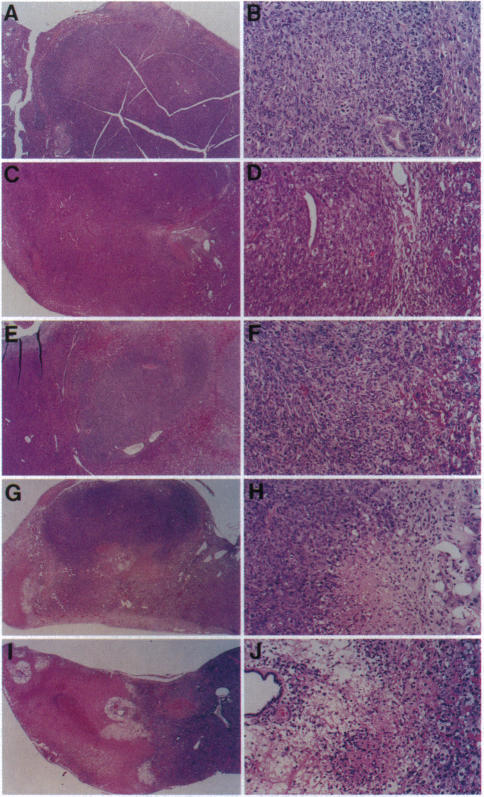
The efficacy of combination therapy with a "suicide gene" and a cytokine gene to treat metastatic colon carcinoma in the liver was investigated. Tumor in the liver was generated by intrahepatic injection of a colon carcinoma cell line (MCA-26) in syngeneic BALB/c mice. Recombinant adenoviral vectors containing various control and therapeutic genes were injected directly into the solid tumors, followed by treatment with ganciclovir. While the tumors continued to grow in all animals treated with a control vector or a mouse interleukin 2 vector, those treated with a herpes simplex virus thymidine kinase vector, with or without the coadministration of the mouse interleukin 2 vector, exhibited dramatic necrosis and regression. However, only animals treated with both vectors developed an effective systemic antitumoral immunity against challenges of tumorigenic doses of parental tumor cells inoculated at distant sites. The antitumoral immunity was associated with the presence of MCA-26 tumor-specific cytolytic CD8+ T lymphocytes. The results suggest that combination suicide and cytokine gene therapy in vivo can be a powerful approach for treatment of metastatic colon carcinoma in the liver.
研究了“自杀基因”与细胞因子基因联合治疗肝脏转移性结肠癌的疗效。通过向同基因BALB/c小鼠肝内注射结肠癌细胞系(MCA-26)在肝脏中生成肿瘤。将含有各种对照和治疗基因的重组腺病毒载体直接注射到实体瘤中,随后用更昔洛韦进行治疗。在用对照载体或小鼠白细胞介素2载体治疗的所有动物中,肿瘤持续生长,而在用单纯疱疹病毒胸苷激酶载体治疗的动物中,无论是否同时给予小鼠白细胞介素2载体,均出现显著坏死和消退。然而,只有同时接受两种载体治疗的动物对远处接种的致瘤剂量亲本肿瘤细胞的攻击产生了有效的全身抗肿瘤免疫。抗肿瘤免疫与MCA-26肿瘤特异性溶细胞性CD8+T淋巴细胞的存在有关。结果表明,体内联合自杀基因和细胞因子基因治疗可能是治疗肝脏转移性结肠癌的有效方法。