Beavil R L, Graber P, Aubonney N, Bonnefoy J Y, Gould H J
Randall Institute, Kings College London, UK.
Immunology. 1995 Feb;84(2):202-6.
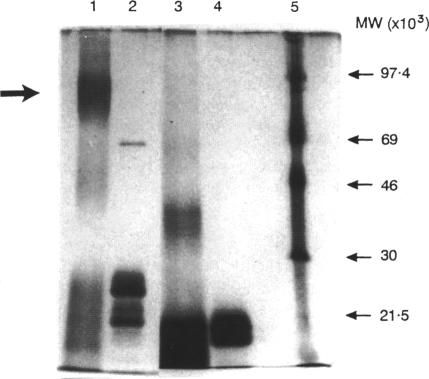
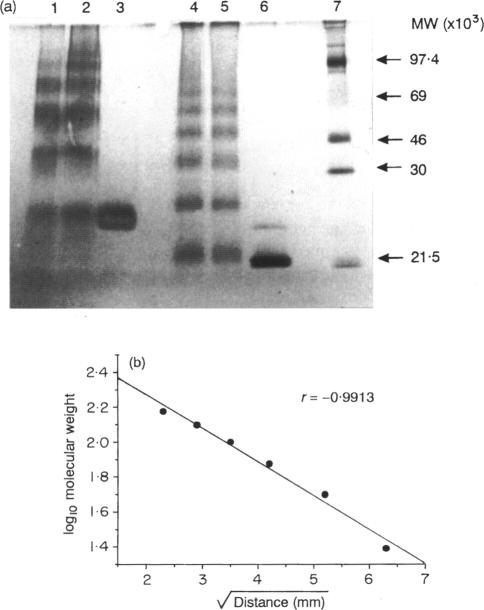
Human CD23 (also known as Fc epsilon RII) is a 45,000 MW glycoprotein with homology to C-type animal lectins. It is involved in B-cell differentiation and IgE regulation, and is naturally cleaved to give soluble products of 37,000, 33,000, 29,000, 25,000 and 16,000 MW. Previous work has suggested that the region between the transmembrane sequence and the extracellular lectin head is capable of forming an alpha-helical coiled coil, one of the main consequences of which would be formation of dimers or trimers. Here we present protein-protein cross-linking data showing that CD23 forms trimers on the cell surface and hexamers in solution, and we use several different fragments to determine the regions of the protein involved in this self-association. The region of the putative coiled coil is indeed responsible for trimerization, with additional interactions between the lectin heads resulting in the formation of hexamers observed in solution.
人类CD23(也称为FcεRII)是一种分子量为45,000的糖蛋白,与C型动物凝集素具有同源性。它参与B细胞分化和IgE调节,并且天然裂解后可产生分子量为37,000、33,000、29,000、25,000和16,000的可溶性产物。先前的研究表明,跨膜序列和细胞外凝集素头部之间的区域能够形成α-螺旋卷曲螺旋,其主要结果之一是形成二聚体或三聚体。在此,我们展示了蛋白质-蛋白质交联数据,表明CD23在细胞表面形成三聚体,在溶液中形成六聚体,并且我们使用几种不同的片段来确定参与这种自我缔合的蛋白质区域。假定的卷曲螺旋区域确实负责三聚化,凝集素头部之间的额外相互作用导致在溶液中观察到六聚体的形成。