Everitt J I, Wolf D C, Howe S R, Goldsworthy T L, Walker C
Department of Experimental Pathology and Toxicology, Chemical Industry Institute of Toxicology, Research Triangle Park, North Carolina 27709, USA.
Am J Pathol. 1995 Jun;146(6):1556-67.
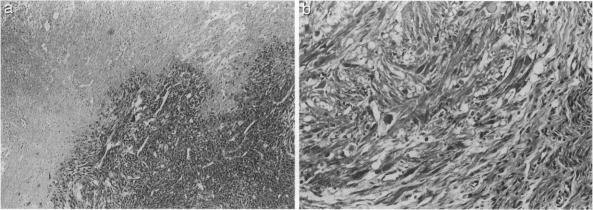
Mesenchymal tumors of the lower reproductive tract of women are poorly understood at the molecular level as a result in part of the lack of relevant animal models. The present study describes a novel model of gynecological smooth muscle tumors in which these neoplasms arise in Eker rats as part of a familial cancer syndrome. The tumors develop as a result of a germline mutation in the tuberous sclerosis 2 (TSC2) gene, and predisposition to tumor development is inherited in an autosomal dominant fashion. Uterine and/or cervical tumors arise spontaneously as single or multicentric neoplasms and increase in incidence with increasing age. The tumors were classified into three phenotypic variants of leiomyoma/leiomyosarcoma and into stromal cervicovaginal tumors on the basis of cytological and histological features and immunostaining patterns for smooth muscle actin and desmin. Tumors histologically identical to the typical human myometrial leiomyoma arose, as did a subset of atypical leiomyomas having an epithelioid phenotype. Eker rats were found to develop both benign and malignant smooth muscle tumors. The high spontaneous incidence of smooth muscle tumors of uterus and cervix in this rodent model provides a unique opportunity to study the molecular mechanisms underlying the development of these clinically important gynecological neoplasms.
由于部分缺乏相关动物模型,女性下生殖道间叶性肿瘤在分子水平上的了解尚少。本研究描述了一种新型的妇科平滑肌瘤模型,其中这些肿瘤在艾克大鼠中作为家族性癌症综合征的一部分出现。这些肿瘤是由于结节性硬化症2(TSC2)基因的种系突变而发生的,肿瘤发生的易感性以常染色体显性方式遗传。子宫和/或宫颈肿瘤以单发或多中心肿瘤的形式自发出现,并且发病率随着年龄的增长而增加。根据细胞学和组织学特征以及平滑肌肌动蛋白和结蛋白的免疫染色模式,将肿瘤分为平滑肌瘤/平滑肌肉瘤的三种表型变体以及基质宫颈阴道肿瘤。出现了组织学上与典型人类子宫肌层平滑肌瘤相同的肿瘤,以及具有上皮样表型的非典型平滑肌瘤子集。发现艾克大鼠会发生良性和恶性平滑肌瘤。这种啮齿动物模型中子宫和宫颈平滑肌瘤的高自发发病率为研究这些临床上重要的妇科肿瘤发生的分子机制提供了独特的机会。