Bonafé N, Chaussepied P
Centre de Recherches de Biochimie Macromoléculaire du Centre National de Recherche Scientifique, Montpellier, France.
Biophys J. 1995 Apr;68(4 Suppl):35S-43S.
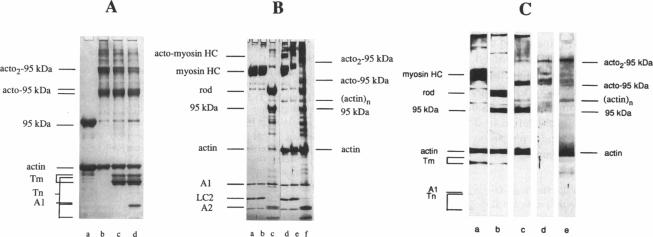
Myosin subfragment-1 (S1) can be cross-linked to two actin monomers by 1-ethyl-3-[3-(dimethylamino)-propyl]-carbodiimide only when F-actin is in excess over S1. Electron micrographs of the covalent actin2-S1 complex showed that S1 was cross-linked to two adjacent monomers of the same actin filament. Cross-linking experiments with pre-proteolyzed S1 derivatives in combination with a proteolytic dissection of the intact covalent actin2-S1 adduct (m = 265 kDa), revealed that two N-terminal segments of actin (residues 1-28) were covalently attached to a single S1 molecule. One was cross-linked to either the 20-kDa or the 50-kDa heavy chain fragments of S1, and the other only to the 50-kDa region. The doubly cross-linked product was formed under physiological ionic strength with S1 or with reconstituted myosin filaments, regardless of the presence of ADP or the regulatory proteins, tropomyosin and troponin. Finally, we found that this cross-linking could also take place within myofibrils in the rigor state. These results demonstrate that under nonsaturating conditions, the actin-S1 interface encompasses a much larger region than that recently proposed for the nonphysiological, fully saturated actin filaments.
只有当F-肌动蛋白的量超过肌球蛋白亚片段-1(S1)时,1-乙基-3-[3-(二甲基氨基)丙基]-碳二亚胺才能将S1与两个肌动蛋白单体交联。共价肌动蛋白2-S1复合物的电子显微镜照片显示,S1与同一肌动蛋白丝的两个相邻单体交联。用预先蛋白酶解的S1衍生物进行交联实验,并结合对完整共价肌动蛋白2-S1加合物(m = 265 kDa)的蛋白酶解分析,结果表明,肌动蛋白的两个N端片段(第1-28位氨基酸残基)共价连接到单个S1分子上。其中一个片段与S1的20 kDa或50 kDa重链片段交联,另一个仅与50 kDa区域交联。无论是否存在ADP或调节蛋白原肌球蛋白和肌钙蛋白,在生理离子强度下,S1或重组肌球蛋白丝均可形成双交联产物。最后,我们发现这种交联也可以在处于僵直状态的肌原纤维内发生。这些结果表明,在非饱和条件下,肌动蛋白-S1界面所涵盖的区域比最近针对非生理性、完全饱和的肌动蛋白丝所提出的区域要大得多。