Muntoni F, Melis M A, Ganau A, Dubowitz V
Department of Paediatrics and Neonatal Medicine, Royal Postgraduate Medical School, Hammersmith Hospital, London, United Kingdom.
Am J Hum Genet. 1995 Jan;56(1):151-7.
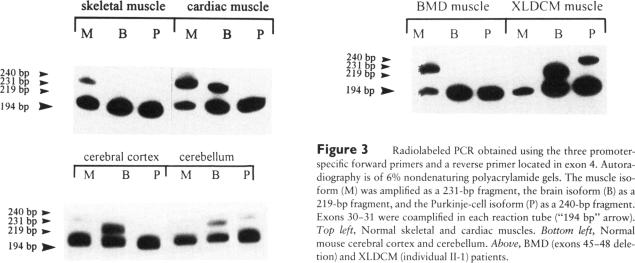
We recently described a family where a deletion of the dystrophin gene was associated with a severe dilated cardiomyopathy without skeletal muscle weakness. The deletion removed the muscle promoter region and the first muscle exon, but not the brain or Purkinje-cell promoters. Dystrophin was detected immunocytochemically in the skeletal muscle from this family, despite the fact that the deletion eliminated the transcriptional start site of the muscle isoform. In order to determine which promoter was driving dystrophin transcription in skeletal muscle of these individuals, we first evaluated the expression of the exon 1 of muscle, brain, and Purkinje-cell isoforms in normal human skeletal and cardiac muscles and in mouse brain and cerebellum. Our data indicate that, with the exception of minimal expression of the brain isoform, only the muscle isoform is significantly transcribed in skeletal muscle, whereas both the exon 1 muscle and brain isoforms are highly expressed in cardiac muscle. In contrast to what is observed in normal muscle, the skeletal muscle of our patients showed expression of both the brain and the Purkinje-cell isoforms. The overexpression, in skeletal muscle, of these two isoforms thus appears to be of crucial importance in preventing a myopathy in these affected males. The reason for the severe cardiomyopathy remains speculative, in the absence of dystrophin data on their heart. However, we have found in the 5' end of intron 1, a region deleted in our cases, regulatory sequences that might be of importance for dystrophin expression in various tissues.(ABSTRACT TRUNCATED AT 250 WORDS)
我们最近描述了一个家系,其中肌营养不良蛋白基因的缺失与严重的扩张型心肌病相关,但无骨骼肌无力症状。该缺失去除了肌肉启动子区域和第一个肌肉外显子,但未涉及脑或浦肯野细胞启动子。尽管该缺失消除了肌肉异构体的转录起始位点,但通过免疫细胞化学方法在这个家系的骨骼肌中检测到了肌营养不良蛋白。为了确定在这些个体的骨骼肌中驱动肌营养不良蛋白转录的是哪个启动子,我们首先评估了正常人类骨骼肌和心肌以及小鼠脑和小脑中肌肉、脑和浦肯野细胞异构体的外显子1的表达情况。我们的数据表明,除了脑异构体有少量表达外,在骨骼肌中只有肌肉异构体有显著转录,而在心肌中肌肉和脑异构体的外显子1均高表达。与正常肌肉中观察到的情况相反,我们患者的骨骼肌显示出脑和浦肯野细胞异构体均有表达。因此,这两种异构体在骨骼肌中的过表达似乎对预防这些受影响男性的肌病至关重要。在没有他们心脏的肌营养不良蛋白数据的情况下,严重心肌病的原因仍属推测。然而,我们在第1内含子的5'端(我们病例中缺失的区域)发现了可能对肌营养不良蛋白在各种组织中的表达很重要的调控序列。(摘要截选至250词)