Herskowitz A, Choi S, Ansari A A, Wesselingh S
Department of Medicine, Johns Hopkins Medical Institutions, Baltimore, Maryland.
Am J Pathol. 1995 Feb;146(2):419-28.
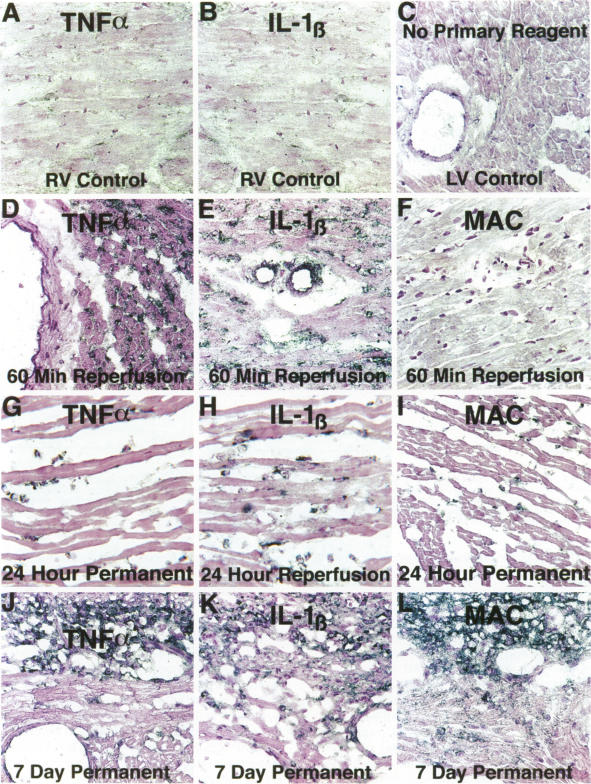
While the role of cytokines in mediating injury during hind limb skeletal muscle ischemia followed by reperfusion has recently been described, the role of cytokines in myocardial infarction and ischemia/reperfusion have remained relatively unexplored. We hypothesize that cytokines play an important role in the regulation of postischemic myocardial inflammation. This study reports the temporal sequence of proinflammatory cytokine gene expression in postischemic/reperfused myocardium and localizes interleukin-1 beta (IL-1 beta) and tumor necrosis factor-alpha (TNF-alpha)-protein by immunostaining. Rats were subjected to either permanent left anterior descending (LAD) occlusion or to 35 minutes of LAD occlusion followed by reperfusion and sacrificed up to 7 days later. Rat-specific oligonucleotide probes were used to semiquantitatively assess the relative expression of mRNA for TNF-alpha, IL-1 beta, IL-2, IL-6, interferon-gamma (IFN-gamma), and transforming growth factor-beta 1 (TGF-beta 1) utilizing the reverse transcriptase-polymerase chain reaction amplification technique. Increased cardiac mRNA levels for all cytokines except IL-6 and IFN-gamma were measurable within 15 to 30 minutes of LAD occlusion and increased levels were generally sustained for 3 hours. During early reperfusion, mRNA levels for IL-6 and TGF-beta 1 were significantly reduced compared with permanent LAD occlusion. In both groups, cytokine mRNA levels all returned to baseline levels at 24 hours, while IL-1 beta, TNF-alpha, and TGF-beta 1 mRNA levels again rose significantly at 7 days only in animals with permanent LAD occlusion. Immunostaining for IL-1 beta and TNF-alpha protein revealed two patterns of reactivity: 1) microvascular staining for both IL-1 beta and TNF-alpha protein only in postischemic reperfused myocardium in early post-reperfusion time points; and 2) staining of infiltrating macrophages in healing infarct zones which was most prominent at 7 days after permanent LAD occlusion. These results provide evidence for local expression of cytokine mRNA in postischemic myocardium and suggest that regulation of local cytokine release is altered during the postischemic period.
虽然细胞因子在介导后肢骨骼肌缺血再灌注损伤中的作用最近已有报道,但细胞因子在心肌梗死和缺血/再灌注中的作用仍相对未被充分研究。我们假设细胞因子在缺血后心肌炎症的调节中起重要作用。本研究报告了缺血/再灌注心肌中促炎细胞因子基因表达的时间顺序,并通过免疫染色定位白细胞介素-1β(IL-1β)和肿瘤坏死因子-α(TNF-α)蛋白。将大鼠进行永久性左前降支(LAD)闭塞或LAD闭塞35分钟后再灌注,并在7天内处死。使用大鼠特异性寡核苷酸探针,利用逆转录聚合酶链反应扩增技术半定量评估TNF-α、IL-1β、IL-2、IL-6、干扰素-γ(IFN-γ)和转化生长因子-β1(TGF-β1)mRNA的相对表达。除IL-6和IFN-γ外,所有细胞因子的心脏mRNA水平在LAD闭塞后15至30分钟内均可测量到升高,且升高水平通常持续3小时。在早期再灌注期间,与永久性LAD闭塞相比,IL-6和TGF-β1的mRNA水平显著降低。在两组中,细胞因子mRNA水平在24小时均恢复到基线水平,而仅在永久性LAD闭塞的动物中,IL-1β、TNF-α和TGF-β1的mRNA水平在7天时再次显著升高。IL-1β和TNF-α蛋白的免疫染色显示出两种反应模式:1)仅在再灌注后早期缺血再灌注心肌中,IL-1β和TNF-α蛋白的微血管染色;2)在愈合梗死区浸润巨噬细胞的染色,在永久性LAD闭塞后7天最为明显。这些结果为缺血后心肌中细胞因子mRNA的局部表达提供了证据,并表明在缺血后时期局部细胞因子释放的调节发生了改变。