Archer V E, Breton J, Sanchez-Garcia I, Osada H, Forster A, Thomson A J, Rabbitts T H
Medical Research Council Laboratory of Molecular Biology, Cambridge, United Kingdom.
Proc Natl Acad Sci U S A. 1994 Jan 4;91(1):316-20. doi: 10.1073/pnas.91.1.316.
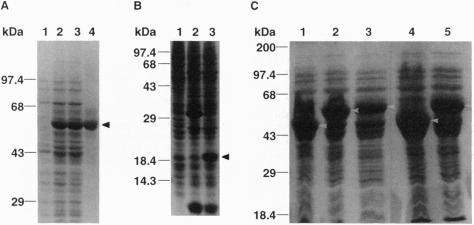
The structure of LIM domains has major implications for transcription because proteins such as Is1-1 contain two LIM domains associated with a homeodomain, and RBTN1/Ttg-1 and RBTN2/Ttg-2 contain two LIM domains but no homeodomain. Conserved cysteine and histidine residues in the LIM domains suggest a metal-binding role. RBTN and Is1-1 LIM proteins have been made in Escherichia coli and insect cell expression systems and their metal content has been determined using atomic absorption spectroscopy and electron paramagnetic resonance spectroscopy. LIM proteins expressed in soluble form contain zinc atoms, whereas bacterial inclusion bodies invariably also have Fe-S clusters. The latter are identified as linear [Fe3S4]+ clusters and appear to result from incorrect metal coordination by E. coli. These studies show that RBTN1, RBTN2, and Is1-1 are metalloproteins that contain zinc but not iron and, therefore, that the LIM domain represents a zinc-binding domain.
LIM结构域的结构对转录具有重要意义,因为诸如Is1-1等蛋白质包含两个与同源结构域相关的LIM结构域,而RBTN1/Ttg-1和RBTN2/Ttg-2包含两个LIM结构域但没有同源结构域。LIM结构域中保守的半胱氨酸和组氨酸残基表明其具有金属结合作用。RBTN和Is1-1 LIM蛋白已在大肠杆菌和昆虫细胞表达系统中制备,并且使用原子吸收光谱法和电子顺磁共振光谱法测定了它们的金属含量。以可溶形式表达的LIM蛋白含有锌原子,而细菌包涵体中总是也含有铁硫簇。后者被鉴定为线性[Fe3S4]+簇,似乎是由大肠杆菌不正确的金属配位导致的。这些研究表明,RBTN1、RBTN2和Is1-1是含有锌但不含铁的金属蛋白,因此,LIM结构域代表一个锌结合结构域。