Maruyama M, Hay J G, Yoshimura K, Chu C S, Crystal R G
Pulmonary Branch, National Heart, Lung, and Blood Institute, National Institutes of Health, Bethesda, Maryland 20892.
J Clin Invest. 1994 Jul;94(1):368-75. doi: 10.1172/JCI117331.
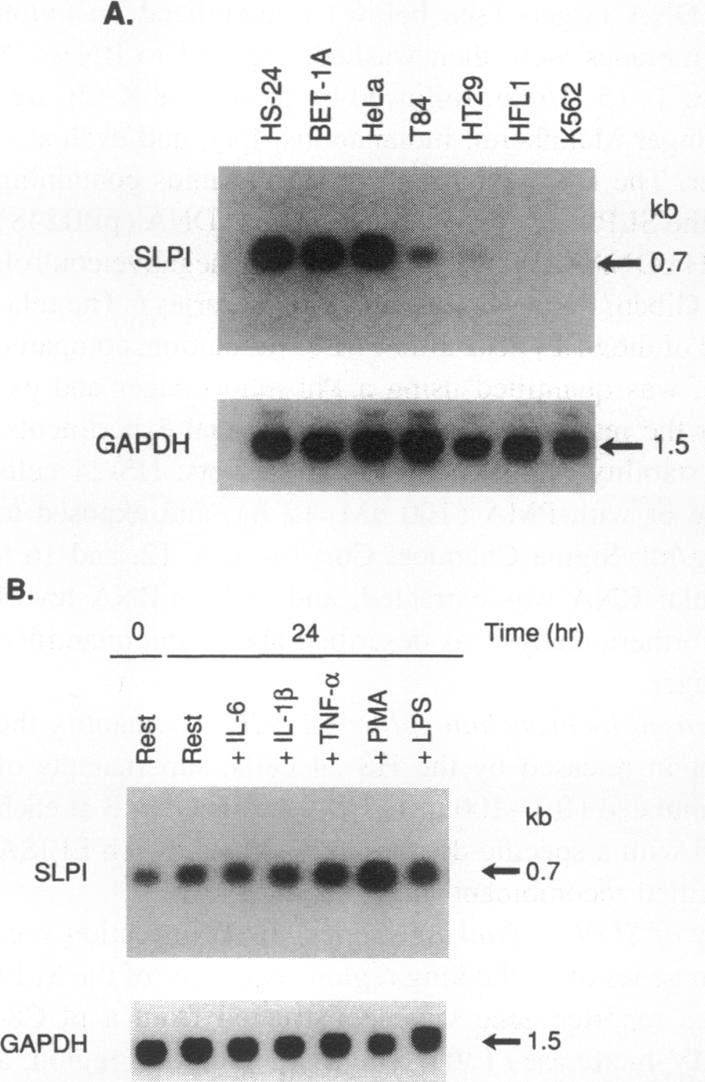
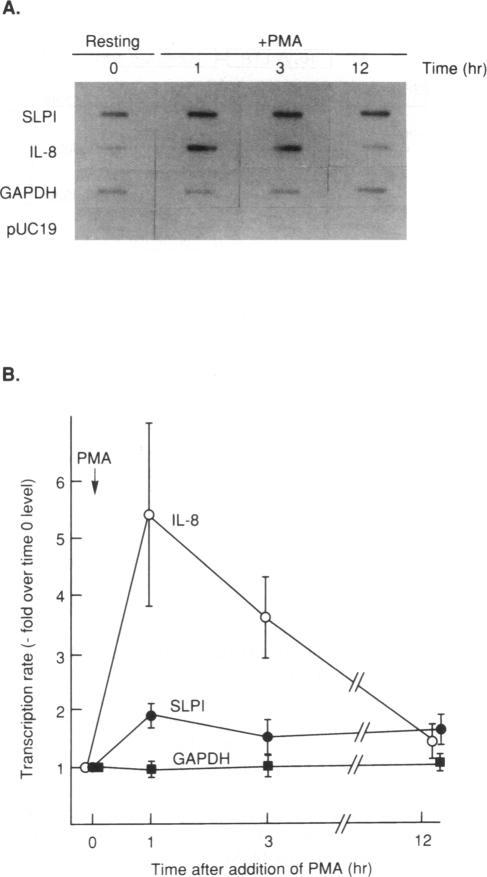
Secretory leukoprotease inhibitor (SLPI), a 12-kD nonglycosylated serine antiprotease, helps to protect the epithelial surface of the airways from the destructive capacity of neutrophil elastase. Based on the recognition that SLPI levels can increase in the presence of airway inflammation, we hypothesized that inflammatory stimuli should modulate the expression of the SLPI gene in airway epithelial cells. To evaluate this, the modulation of SLPI gene expression with various inflammatory stimuli was evaluated in the HS-24 human bronchial epithelial cell line. After preliminary studies showed that several inflammatory mediators enhanced SLPI messenger RNA (mRNA) levels, PMA was used as a model inflammatory stimulus. PMA significantly increased the level of 0.7-kb SLPI mRNA transcripts in HS-24 cells in a dose- and time-dependent fashion and increased the amount of SLPI protein in the culture supernatant. Nuclear run-on analyses showed that the SLPI gene transcription rate increased approximately twofold after PMA stimulation. Transfection studies using fusion genes composed of fragments of up to 1.2 kb of the 5' flanking sequence of the SLPI gene and a luciferase reporter gene demonstrated potent promoter activity in the 131-bp segment (-115 to +16 relative to the transcription start site), and all longer segments up to 1.2 kb, whereas smaller segments showed low promoter activity. An 18-bp element (-98 to -115), in a region with homology to PMA-responsive regions in the Moloney murine leukemia virus enhancer and the IL-8 gene, was shown to be of importance in the level of transcription of the SLPI gene. However, this element was not responsible for the upregulation of SLPI gene expression by PMA. Evaluation of HS-24 cells in the presence of actinomycin D demonstrated that SLPI mRNA transcripts were very stable and became more so in the presence of PMA. Thus, SLPI gene expression in airway epithelial cells can be upregulated by an inflammatory stimulus, and this modulation is regulated at both the transcriptional and posttranscriptional levels. These mechanisms of SLPI upregulation likely play a role in defending the epithelial surface in the local milieu of inflammatory lung diseases.
分泌型白细胞蛋白酶抑制剂(SLPI)是一种12千道尔顿的非糖基化丝氨酸抗蛋白酶,有助于保护气道上皮表面免受中性粒细胞弹性蛋白酶的破坏作用。基于气道炎症时SLPI水平会升高这一认识,我们推测炎症刺激应可调节气道上皮细胞中SLPI基因的表达。为评估这一点,在HS - 24人支气管上皮细胞系中评估了各种炎症刺激对SLPI基因表达的调节作用。初步研究表明几种炎症介质可增强SLPI信使核糖核酸(mRNA)水平后,将佛波酯(PMA)用作模型炎症刺激物。PMA以剂量和时间依赖性方式显著增加了HS - 24细胞中0.7千碱基SLPI mRNA转录本的水平,并增加了培养上清液中SLPI蛋白的量。核转录分析表明,PMA刺激后SLPI基因转录率增加了约两倍。使用由SLPI基因5'侧翼序列长达1.2千碱基的片段与荧光素酶报告基因组成的融合基因进行的转染研究表明,在131碱基对片段(相对于转录起始位点为-115至+16)以及长达1.2千碱基的所有更长片段中均有强大的启动子活性,而较小片段显示出低启动子活性。在与莫洛尼鼠白血病病毒增强子和白细胞介素-8基因中的PMA反应区域具有同源性的区域中的一个18碱基对元件(-98至-115),被证明对SLPI基因的转录水平很重要。然而,该元件并非PMA上调SLPI基因表达的原因。在放线菌素D存在下对HS - 24细胞的评估表明,SLPI mRNA转录本非常稳定,且在PMA存在时更稳定。因此,气道上皮细胞中SLPI基因的表达可被炎症刺激上调,且这种调节在转录和转录后水平均受到调控。SLPI上调的这些机制可能在炎症性肺部疾病的局部环境中保护上皮表面发挥作用。