Peverali F A, Ramqvist T, Saffrich R, Pepperkok R, Barone M V, Philipson L
European Molecular Biology Laboratory, Heidelberg, Germany.
EMBO J. 1994 Sep 15;13(18):4291-301. doi: 10.1002/j.1460-2075.1994.tb06749.x.
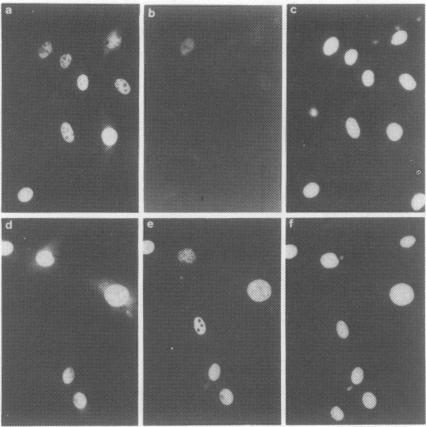
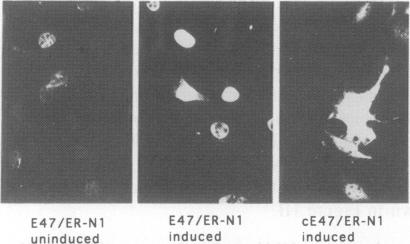
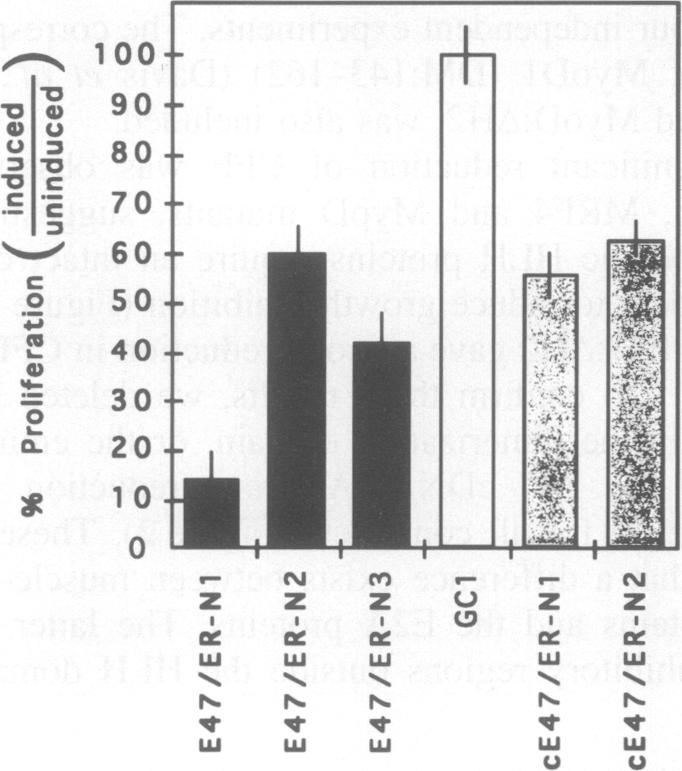
In NIH3T3 fibroblasts, the ubiquitous helix-loop-helix (HLH) protein E2A (E12/E47) and the myogenic HLH proteins MyoD, MRF4 and myogenin are growth-inhibitory, while two ubiquitous Id proteins lacking the basic region are not. The dimerization domain mediates inhibition. However, in addition to the HLH region, E2A contains two inhibitory regions over-lapping with the main transcriptional activation domains. The growth-suppressive activity of the intact E47 as well as MyoD was counteracted by the Id proteins. When E47 lacking the HLH domain was overexpressed, Id could no longer reverse growth inhibition. By increasing the amount of E47 with an inducible system or neutralizing the endogenous Id with microinjected anti-Id antibodies, withdrawal from the cell cycle occurred within hours before the G1-S transition point. The combined results suggest that the Id proteins are required for G1 progression. The antagonism between the E2A and Id proteins further suggests that both are involved in regulatory events prior to or near the restriction point in the G1 phase of the cell cycle.
在NIH3T3成纤维细胞中,普遍存在的螺旋-环-螺旋(HLH)蛋白E2A(E12/E47)和生肌HLH蛋白MyoD、MRF4及肌细胞生成素具有生长抑制作用,而两种缺乏碱性区域的普遍存在的Id蛋白则没有。二聚化结构域介导抑制作用。然而,除了HLH区域外,E2A还包含两个与主要转录激活结构域重叠的抑制区域。完整的E47以及MyoD的生长抑制活性被Id蛋白抵消。当缺乏HLH结构域的E47过表达时,Id不再能逆转生长抑制。通过诱导系统增加E47的量或用显微注射的抗Id抗体中和内源性Id,在G1-S转换点前数小时内细胞周期退出发生。综合结果表明Id蛋白是G1期进程所必需的。E2A和Id蛋白之间的拮抗作用进一步表明两者都参与细胞周期G1期限制点之前或附近的调节事件。