Komoda Y, Hijikata M, Sato S, Asabe S, Kimura K, Shimotohno K
Virology Division, National Cancer Center Research Institute, Tokyo, Japan.
J Virol. 1994 Nov;68(11):7351-7. doi: 10.1128/JVI.68.11.7351-7357.1994.
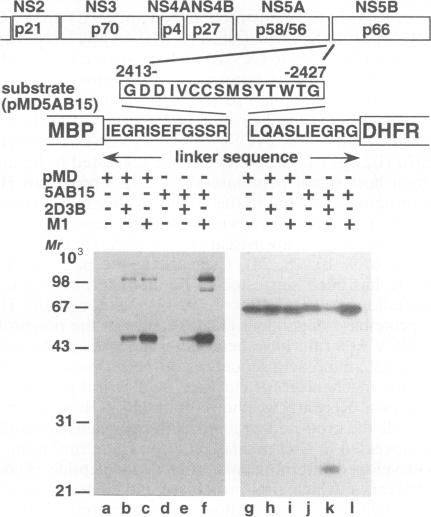
Using as substrates a series of chimeric proteins containing various fragments of the hepatitis C virus precursor polyprotein between Escherichia coli maltose binding protein and dihydrofolate reductase, we analyzed the substrate requirements of hepatitis C viral serine proteinase (Cpro-2) for intermolecular polypeptide cleavage in E. coli. Cpro-2-dependent substrate cleavage was observed in E. coli cells simultaneously transformed with expression plasmids for the Cpro-2 molecule and substrate protein. The cleavage sites were estimated by determining the amino (N)-terminal amino acid sequences of dihydrofolate reductase-fused processed products purified partially by affinity chromatography from the lysates, indicating that cleavage occurred at sites identical to those observed in eukaryotic cells. Mutation analysis using the chimeric substrate indicated that the presence of cysteine and small uncharged residues at positions P1 and P1', respectively, of the putative cleavage site is necessary for cleavage and that acidic residues in the region upstream of the cleavage site are required for efficient cleavage.
我们以一系列嵌合蛋白作为底物,这些嵌合蛋白包含丙型肝炎病毒前体多蛋白在大肠杆菌麦芽糖结合蛋白和二氢叶酸还原酶之间的各种片段,以此分析丙型肝炎病毒丝氨酸蛋白酶(Cpro-2)在大肠杆菌中进行分子间多肽切割的底物需求。在用Cpro-2分子和底物蛋白的表达质粒同时转化的大肠杆菌细胞中观察到了依赖Cpro-2的底物切割。通过测定从裂解物中经亲和层析部分纯化的二氢叶酸还原酶融合加工产物的氨基(N)末端氨基酸序列来估计切割位点,这表明切割发生在与真核细胞中观察到的相同位点。使用嵌合底物的突变分析表明,在假定切割位点的P1和P1'位置分别存在半胱氨酸和小的不带电荷的残基对于切割是必需的,并且切割位点上游区域中的酸性残基对于有效切割是必需的。