Siegel P M, Dankort D L, Hardy W R, Muller W J
Institute for Molecular Biology and Biotechnology, McMaster University, Hamilton, Ontario, Canada.
Mol Cell Biol. 1994 Nov;14(11):7068-77. doi: 10.1128/mcb.14.11.7068-7077.1994.
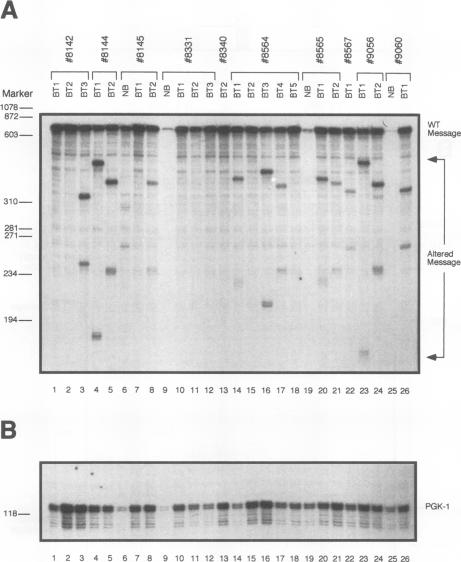
Amplification of the Neu/c-erbB-2 receptor tyrosine kinase has been implicated as an important event in the genesis of human breast cancer. Indeed, transgenic mice bearing either an activated form of neu or the wild-type proto-oncogene under the transcriptional control of the mouse mammary tumor virus promoter-enhancer frequently develop mammary carcinomas (L. Bouchard, L. Lamarre, P. J. Tremblay, and P. Jolicoeur, Cell 57:931-936, 1989; C. T. Guy, M. A. Webster, M. Schaller, T. J. Parson, R. D. Cardiff, and W. J. Muller, Proc. Natl. Acad. Sci. USA 89:10578-10582, 1992; W. J. Muller, E. Sinn, R. Wallace, P. K. Pattengale, and P. Leder, Cell 54:105-115, 1988). Induction of mammary tumors in transgenic mice expressing the wild-type Neu receptor is associated with activation of the receptor's intrinsic tyrosine kinase activity (Guy et al., Proc. Natl. Acad. Sci. USA 89:10578-10582, 1992). Here, we demonstrate that activation of Neu in these transgenic mice occurs through somatic mutations located within the transgene itself. Sequence analyses of these mutations revealed that they contain in-frame deletions of 7 to 12 amino acids in the extracellular region proximal to the transmembrane domain. Introduction of these mutations into a wild-type neu cDNA results in an increased transforming ability of the altered Neu tyrosine kinase. These observations suggest that oncogenic activation of Neu in mammary tumorigenesis frequently occurs by somatic mutation.
Neu/c-erbB-2受体酪氨酸激酶的扩增被认为是人类乳腺癌发生过程中的一个重要事件。事实上,在小鼠乳腺肿瘤病毒启动子-增强子的转录控制下携带激活形式的neu或野生型原癌基因的转基因小鼠经常发生乳腺癌(L. Bouchard、L. Lamarre、P. J. Tremblay和P. Jolicoeur,《细胞》57:931-936,1989;C. T. Guy、M. A. Webster、M. Schaller、T. J. Parson、R. D. Cardiff和W. J. Muller,《美国国家科学院院刊》89:10578-10582,1992;W. J. Muller、E. Sinn、R. Wallace、P. K. Pattengale和P. Leder,《细胞》54:105-115,1988)。在表达野生型Neu受体的转基因小鼠中诱导乳腺肿瘤与受体内在酪氨酸激酶活性的激活有关(Guy等人,《美国国家科学院院刊》89:10578-10582,1992)。在这里,我们证明这些转基因小鼠中Neu的激活是通过位于转基因本身内的体细胞突变发生的。对这些突变的序列分析表明,它们在靠近跨膜结构域的细胞外区域包含7至12个氨基酸的框内缺失。将这些突变引入野生型neu cDNA会导致改变后的Neu酪氨酸激酶的转化能力增强。这些观察结果表明,在乳腺肿瘤发生过程中Neu的致癌激活经常通过体细胞突变发生。