Michiels F M, Caillou B, Talbot M, Dessarps-Freichey F, Maunoury M T, Schlumberger M, Mercken L, Monier R, Feunteun J
Laboratoire d'Oncologie Moléculaire, Centre National de la Recherche Scientifique Unité de Recherche Associée 1158, Institut Gustave Roussy, Villejuif, France.
Proc Natl Acad Sci U S A. 1994 Oct 25;91(22):10488-92. doi: 10.1073/pnas.91.22.10488.
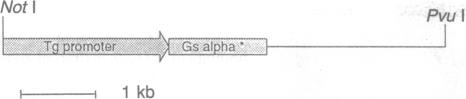
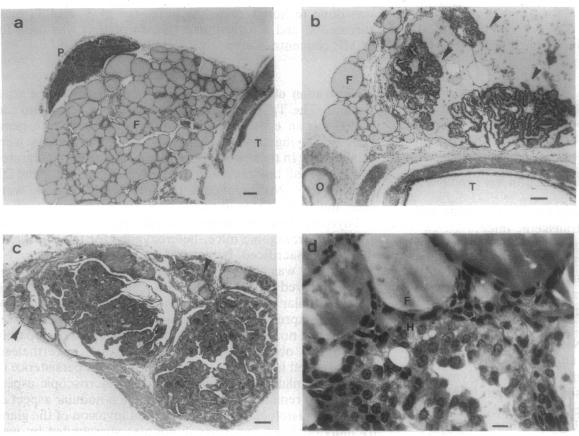
Transgenic mice have been used to address the issue of the oncogenic potential of mutant guanine nucleotide stimulatory factor (Gs) alpha subunit in the thyroid gland. The expression of the mutant Arg-201-->His Gs alpha subunit transgene has been directed to murine thyroid epithelial cells by bovine thyroglobulin promoter. The transgenic animals develop hyperfunctioning thyroid adenomas with increased intracellular cAMP levels and high uptake of [125I]iodine and produced elevated levels of circulating triiodothyronine and thyroxine. These animals demonstrate that the mutant form of Gs alpha subunit carries an oncogenic activity, thus supporting the model that deregulation of cAMP level alters growth control in thyroid epithelium. These animals represent models for humans with autonomously functioning thyroid nodules.
转基因小鼠已被用于研究甲状腺中突变型鸟嘌呤核苷酸刺激因子(Gs)α亚基的致癌潜力问题。突变型精氨酸-201→组氨酸Gsα亚基转基因的表达已通过牛甲状腺球蛋白启动子定向到小鼠甲状腺上皮细胞。转基因动物发展出功能亢进的甲状腺腺瘤,细胞内cAMP水平升高,[125I]碘摄取量高,循环中三碘甲状腺原氨酸和甲状腺素水平升高。这些动物表明,Gsα亚基的突变形式具有致癌活性,从而支持了cAMP水平失调会改变甲状腺上皮细胞生长控制的模型。这些动物代表了具有自主功能性甲状腺结节的人类模型。