McCulloch T A, Harper S J, Donnelly P K, Moorhouse J, Bell P R, Walls J, Feehally J, Furness P N
Department of Histopathology, Royal Hallamshire Hospital, Sheffield.
J Clin Pathol. 1994 Sep;47(9):839-42. doi: 10.1136/jcp.47.9.839.
To compare the degree of interstitial fibrosis in renal transplant biopsy specimens from immunosuppressed patients using conventional doses of cyclosporin with and without calcium channel blockade with a combination of low dose cyclosporin and azathioprine; to correlate the degree of interstitial fibrosis with the glomerular filtration rate.
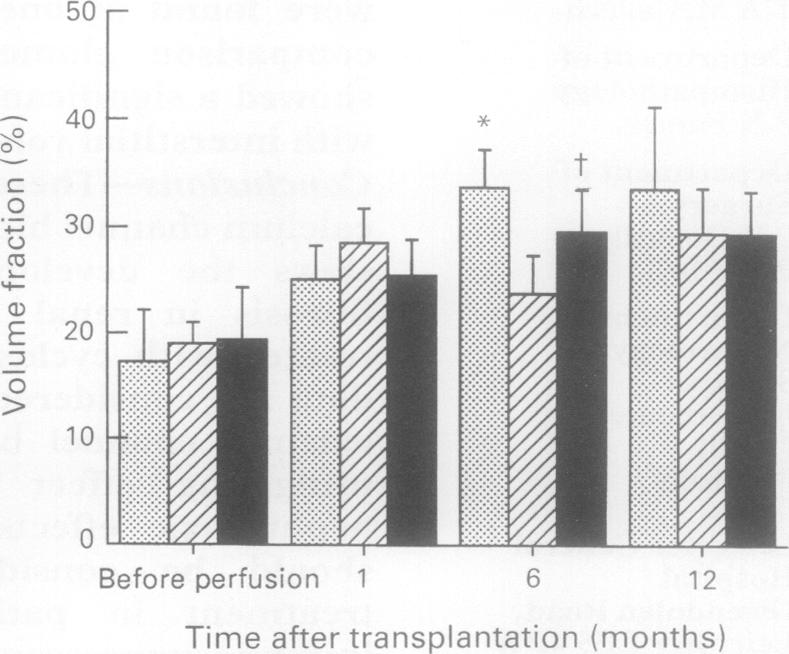
A single blind histomorphometric assessment was done of cortical interstitial volume fraction from biopsy specimens taken intraoperatively and at one, six, and 12 months after transplantation from three prospectively randomised groups of patients: (A) conventional dose cyclosporin; (B) conventional dose cyclosporin plus nifedipine; (C) low dose cyclosporin plus azathioprine.
Interstitial volume increased with time in all groups. No differences in interstitial volume were present at operation or at one month, but at six months interstitial volume was significantly less in group B than group A (p < 0.001) or group C (p < 0.05). More grafts failed in group A than group B leaving only small numbers for comparison at 12 months. At 12 months the differences persisted but did not reach significance. These results strongly reflected the clinical findings, where glomerular filtration rate was significantly lower in group A than groups B or C at six and 12 months; no differences in glomerular filtration rate were found at one month. In a direct comparison glomerular filtration rate showed a significant negative correlation with interstitial volume fraction.
These findings suggest that calcium channel blockade with nifedipine slows the development of interstitial fibrosis in renal transplant recipients treated with cyclosporin. When clinical data are considered, it is suggested that calcium channel blockade may have a mitigating effect on the long term nephrotoxic effects of cyclosporin and should be considered as adjunctive treatment in patients requiring this immunosuppressant following renal transplantation.
比较接受常规剂量环孢素且联合或不联合钙通道阻滞剂治疗的免疫抑制肾移植患者活检标本中的间质纤维化程度,与接受低剂量环孢素和硫唑嘌呤联合治疗的患者的间质纤维化程度;并将间质纤维化程度与肾小球滤过率进行关联分析。
对三组前瞻性随机分组患者术中及移植后1个月、6个月和12个月所取活检标本的皮质间质体积分数进行单盲组织形态计量学评估:(A)常规剂量环孢素组;(B)常规剂量环孢素加硝苯地平组;(C)低剂量环孢素加硫唑嘌呤组。
所有组间质体积均随时间增加。手术时及1个月时间质体积无差异,但6个月时,B组间质体积显著小于A组(p<0.001)和C组(p<0.05)。A组移植失败的移植物比B组多,因此12个月时可供比较的移植物数量很少。12个月时差异仍然存在,但未达到显著水平。这些结果有力地反映了临床研究结果,即6个月和12个月时,A组肾小球滤过率显著低于B组和C组;1个月时未发现肾小球滤过率有差异。直接比较显示,肾小球滤过率与间质体积分数呈显著负相关。
这些发现表明,硝苯地平进行钙通道阻滞可减缓接受环孢素治疗的肾移植受者间质纤维化的发展。结合临床数据来看,提示钙通道阻滞可能对环孢素的长期肾毒性作用有缓解作用,对于肾移植后需要这种免疫抑制剂的患者,应考虑将其作为辅助治疗。