Schaad M C, Baric R S
Department of Parasitology, University of North Carolina at Chapel Hill 27599-7400.
J Virol. 1994 Dec;68(12):8169-79. doi: 10.1128/JVI.68.12.8169-8179.1994.
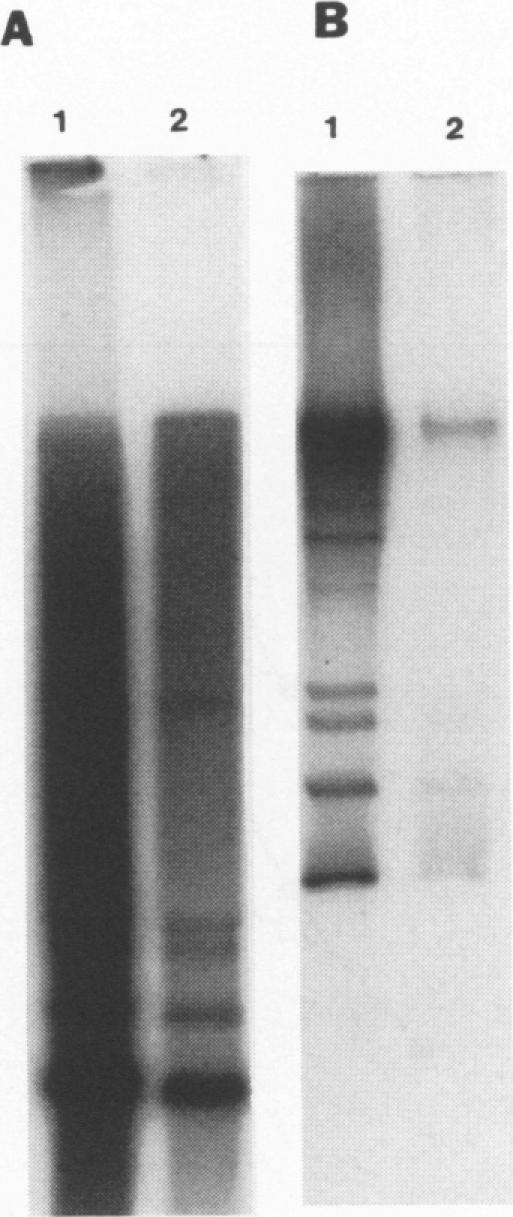
Mouse hepatitis virus (MHV) A59 temperature-sensitive (ts) mutants belonging to complementation group C were characterized and mapped by standard genetic recombination techniques. Temperature shift experiments early in infection suggested that the group C allele can be divided into two phenotypically distinct subgroups, designated C1 and C2. Since previous data indicated that the group C1 mutants probably contained an early defect which affects negative-strand synthesis, RNA synthesis was further examined by analyzing replicative-form (RF) RNA. Full-length as well as subgenomic-length RF RNAs were radiolabeled from 3 to 12 h postinfection (p.i.) and labeled late in infection after shift to the nonpermissive temperature (39.5 degrees C). The relative percent molar ratios of each mRNA and corresponding RF RNA were roughly equivalent throughout infection. Temperature shift experiments at 5.5 or 6.0 h p.i. resulted in an 83 to 92% reduction in the amount of total RF RNA at 39.5 degrees C. Radiolabeling time course experiments after temperature shift to 39.5 degrees C also demonstrated incorporation (6 to 9 h p.i.) into both subgenomic-length and full-length RF RNAs, suggesting that previously transcribed negative strands were functional templates throughout infection. To determine if the reduction in RF RNA was due to a decrease in positive- or negative-strand RNA synthesis, rates of mRNA synthesis were calculated from both full-length and subgenomic-length templates. The rate of mRNA synthesis after the shift was increased at 39.5 degrees C compared with that at 32 degrees C regardless of the template used; however, transcription rates calculated from subgenomic-length templates were similar to those of other viral and eukaryotic polymerases. These findings support the notion that the group C1 allele regulates negative-strand RNA synthesis and strongly suggest that the subgenomic negative-strand RNAs are probably the predominant functional templates for the synthesis of positive-strand RNAs late in infection.
利用标准基因重组技术对属于互补群C的小鼠肝炎病毒(MHV)A59温度敏感(ts)突变体进行了特性分析和定位。感染早期的温度转换实验表明,C组等位基因可分为两个表型不同的亚组,分别命名为C1和C2。由于先前的数据表明C1组突变体可能存在影响负链合成的早期缺陷,因此通过分析复制型(RF)RNA对RNA合成进行了进一步研究。在感染后3至12小时(p.i.)对全长以及亚基因组长度的RF RNA进行放射性标记,并在转移至非允许温度(39.5℃)后在感染后期进行标记。在整个感染过程中,每种mRNA与相应RF RNA的相对摩尔百分比大致相当。在感染后5.5或6.0小时进行温度转换实验,结果显示在39.5℃时总RF RNA量减少了83%至92%。温度转换至39.5℃后的放射性标记时间进程实验也证明了(感染后6至9小时)标记掺入亚基因组长度和全长RF RNA中,这表明先前转录的负链在整个感染过程中都是功能性模板。为了确定RF RNA的减少是由于正链还是负链RNA合成减少所致,从全长和亚基因组长度模板计算了mRNA合成速率。与32℃相比,转换后在39.5℃时mRNA合成速率增加,无论使用何种模板;然而,从亚基因组长度模板计算的转录速率与其他病毒和真核聚合酶的转录速率相似。这些发现支持了C1组等位基因调节负链RNA合成的观点,并强烈表明亚基因组负链RNA可能是感染后期正链RNA合成的主要功能性模板。