Widnell K L, Russell D S, Nestler E J
Department of Pharmacology, Yale University School of Medicine, New Haven, CT.
Proc Natl Acad Sci U S A. 1994 Nov 8;91(23):10947-51. doi: 10.1073/pnas.91.23.10947.
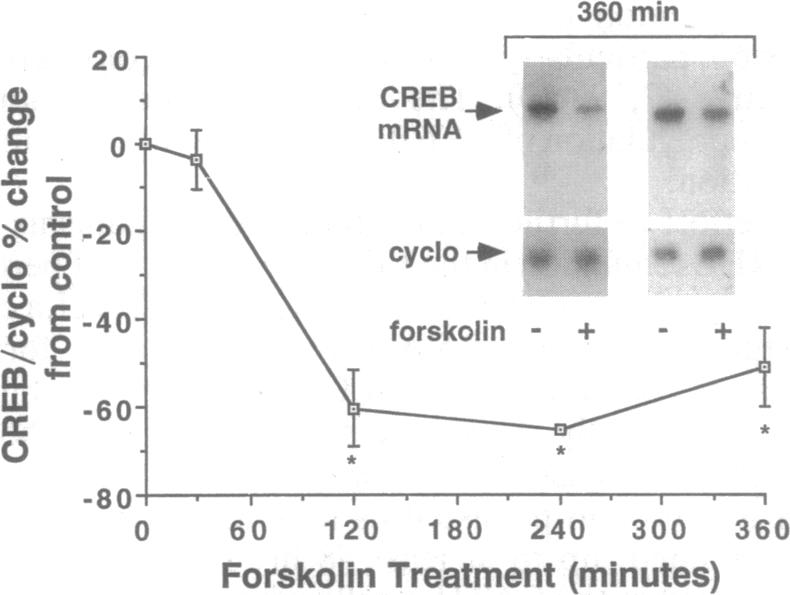
Expression of the cAMP response element (CRE)-binding protein (CREB) has been thought to be constitutive and not subject to regulation. In the course of investigating effects of chronic morphine on the cAMP pathway in the locus coeruleus, a brain region important for opiate addiction, we found that levels of CREB immunoreactivity and CRE binding were increased by chronic morphine administration. To further investigate possible mechanisms underlying this unexpected finding, we studied the regulation of CREB expression in a cell line (CATH.a) that exhibits many properties of locus coeruleus neurons. Agents that activate the cAMP pathway led to a > 60% decrease in CREB mRNA in this cell line. Moreover, these alterations in CREB mRNA levels were associated with changes in levels of CREB immunoreactivity and CRE-binding activity. In contrast, the same treatments fail to alter CREB expression in PC12 pheochromocytoma cells.
环磷酸腺苷反应元件(CRE)结合蛋白(CREB)的表达一直被认为是组成性的,不受调控。在研究慢性吗啡对蓝斑(对阿片类成瘾很重要的脑区)中环磷酸腺苷(cAMP)通路的影响过程中,我们发现慢性给予吗啡会增加CREB免疫反应性水平和CRE结合。为了进一步研究这一意外发现背后的可能机制,我们在一种具有蓝斑神经元许多特性的细胞系(CATH.a)中研究了CREB表达的调控。激活cAMP通路的试剂导致该细胞系中CREB mRNA减少>60%。此外,CREB mRNA水平的这些变化与CREB免疫反应性水平和CRE结合活性的变化相关。相比之下,相同的处理未能改变PC12嗜铬细胞瘤细胞中的CREB表达。