Elaroussi M A, Prahl J M, DeLuca H F
Department of Biochemistry, College of Agriculture and Life Sciences, University of Wisconsin-Madison 53706.
Proc Natl Acad Sci U S A. 1994 Nov 22;91(24):11596-600. doi: 10.1073/pnas.91.24.11596.
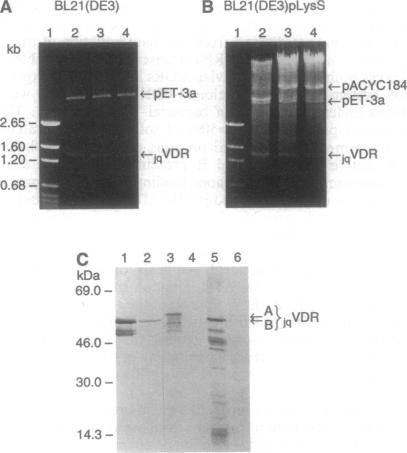
cDNA clones encoding Japanese quail chorioallantoic membrane and chicken kidney 1,25-dihydroxyvitamin D3 receptors were isolated and the total 448-amino acid (aa) sequence was deduced. The sequences of the chicken and quail receptors are identical. The nucleotide and deduced amino acid sequences of the avian receptors are similar but not identical to the reported rat or human receptor sequences. There is a 78% similarity in the nucleotide sequences and 98.5% and 87.5% similarities in the amino acid sequences of the DNA-binding and ligand-binding domains, respectively. Two avian receptor proteins (58 and 60 kDa) arise from a single mRNA transcript by alternate initiation of translation. The avian 1,25-dihydroxyvitamin D3 receptors were produced using a bacterial expression system. Form A receptor was expressed from a cloned cDNA that contains the first translation signal (ATG) and corresponds with the 60-kDa avian receptor protein, and form B receptor was initiated from the third ATG on the same mRNA transcript to give rise to the 58-kDa protein. The cysteine-rich DNA-binding domain is almost conserved among human, rat, and avian receptors. The position of the nine cysteines was conserved in all three sequences. The avian receptor differs in the second zinc finger domain, where a methionine replaces a leucine, a serine replaces an asparagine, and a lysine replaces an arginine at aa 77, 83, and 87, respectively, of the avian sequence. The increased length of the avian receptor results from a 20-aa extension of the N-terminal region. RNA hybridization indicates there is a single mRNA species of approximately 2700 bp for both the chicken and quail receptors compared to 4400 bp for the rat transcript. Surprisingly, the translated avian sequence is larger (448 aa) than the 423-aa rat receptor protein. Therefore, our results confirm that despite the difference in molecular mass between different receptor proteins, there is a similarity in gene organization such that the DNA-binding and hormone-binding domains are positionally conserved from the C terminus.
分离出编码日本鹌鹑绒膜尿囊和鸡肾1,25 - 二羟基维生素D3受体的cDNA克隆,并推导了总共448个氨基酸(aa)的序列。鸡和鹌鹑受体的序列相同。禽类受体的核苷酸和推导的氨基酸序列与已报道的大鼠或人类受体序列相似但不相同。DNA结合域和配体结合域的核苷酸序列相似度为78%,氨基酸序列相似度分别为98.5%和87.5%。两种禽类受体蛋白(58 kDa和60 kDa)由单个mRNA转录本通过交替起始翻译产生。使用细菌表达系统产生禽类1,25 - 二羟基维生素D3受体。A形式受体由包含第一个翻译信号(ATG)的克隆cDNA表达,对应于60 kDa的禽类受体蛋白,B形式受体从同一mRNA转录本上的第三个ATG起始,产生58 kDa的蛋白。富含半胱氨酸的DNA结合域在人类、大鼠和禽类受体中几乎保守。九个半胱氨酸的位置在所有三个序列中都保守。禽类受体在第二个锌指结构域有所不同,在禽类序列的第77、83和87位氨基酸处,分别有一个甲硫氨酸取代亮氨酸、一个丝氨酸取代天冬酰胺、一个赖氨酸取代精氨酸。禽类受体长度增加是由于N端区域延长了20个氨基酸。RNA杂交表明,鸡和鹌鹑受体都有一个约2700 bp的单一mRNA种类,而大鼠转录本为4400 bp。令人惊讶的是,翻译后的禽类序列(448个氨基酸)比423个氨基酸的大鼠受体蛋白更大。因此,我们的结果证实,尽管不同受体蛋白的分子量存在差异,但基因组织存在相似性,使得DNA结合域和激素结合域从C端起在位置上是保守的。