Yang S W, Nash H A
Laboratory of Molecular Biology, National Institute of Mental Health, Bethesda, MD 20892-4034.
Proc Natl Acad Sci U S A. 1994 Dec 6;91(25):12183-7. doi: 10.1073/pnas.91.25.12183.
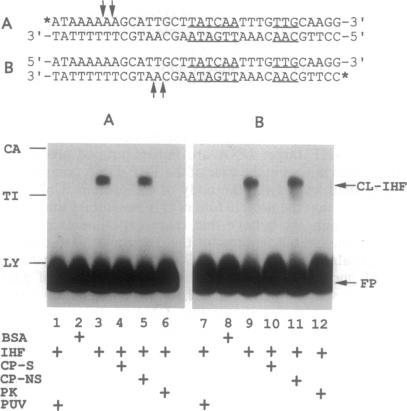
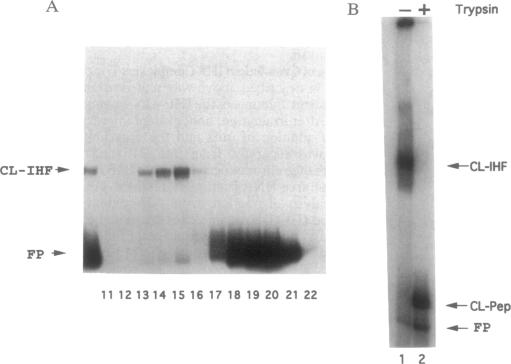
Azide moieties have been specifically placed in the backbone of DNA by chemical coupling between azidophenacyl bromide and uniquely positioned phosphorothioate residues. The derivatized DNA forms specific complexes with a DNA-binding protein and, following irradiation with 302-nm light, makes specific crosslinks to the protein. Isolation of this covalent complex, followed by tryptic digestion and Edman degradation of the resulting crosslinked peptide, identifies the portion of the protein that is near the derivatized segment of the target DNA. We use this method to probe the interaction between a specific DNA sequence and integration host factor (IHF) protein. A single IHF heterodimer is known to contact > 25 bp of DNA and thereby introduce a sharp bend. Two segments of a typical IHF site were derivatized with aryl azide. Although the segments were separated by only 5 bp, they crosslinked to different subunits of IHF. The locations of the crosslinks support our current view for the way IHF protein binds to and bends its specific targets.
通过叠氮苯甲酰溴与独特定位的硫代磷酸酯残基之间的化学偶联,叠氮基团已被特异性地引入到DNA主链中。衍生化的DNA与一种DNA结合蛋白形成特异性复合物,并在302纳米光照射后,与该蛋白形成特异性交联。分离这种共价复合物,随后对所得交联肽进行胰蛋白酶消化和埃德曼降解,可鉴定出蛋白质中靠近目标DNA衍生化片段的部分。我们使用这种方法来探测特定DNA序列与整合宿主因子(IHF)蛋白之间的相互作用。已知单个IHF异二聚体可与超过25个碱基对的DNA接触,从而引入一个急剧的弯曲。典型IHF位点的两个片段用芳基叠氮进行了衍生化。尽管这些片段仅相隔5个碱基对,但它们与IHF的不同亚基发生了交联。交联的位置支持了我们目前对于IHF蛋白结合并弯曲其特定靶点方式的观点。