Hardwick R H, Shepherd N A, Moorghen M, Newcomb P V, Alderson D
University Department of Surgery, Bristol Royal Infirmary.
Gut. 1994 Jun;35(6):764-8. doi: 10.1136/gut.35.6.764.
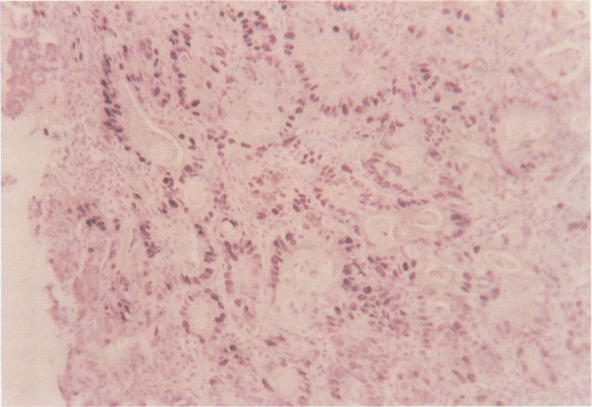
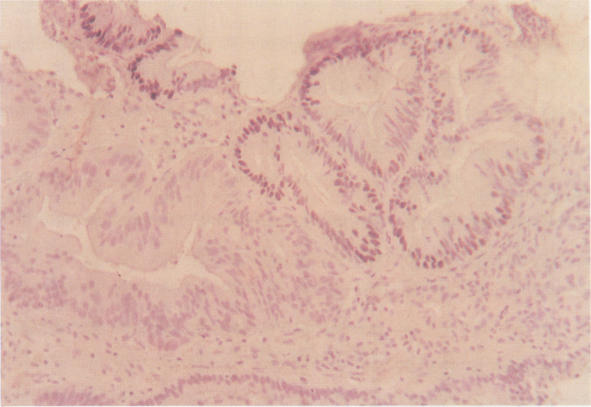
Adenocarcinoma arising in Barrett's oesophagus is often preceded by mucosal dysplasia, but little is currently known about the aetiology or natural history of this dysplasia/carcinoma sequence. To investigate the participation of the tumour suppressor gene p53 in this sequence, an immunohistochemical analysis of p53 protein overexpression, which is known to closely correlate with point mutation of the p53 gene, was conducted in 30 patients with Barrett's adenocarcinoma. Adjacent Barrett's mucosa was dysplastic in 21 (70%) patients. Sixteen (53%) tumours overexpressed p53, 10 of which had adjacent dysplastic Barrett's mucosa. In all 10 patients, this dysplastic mucosa also overexpressed p53, predominantly in areas of high grade compared with low grade dysplasia. In contrast, none of the dysplastic mucosa adjacent to 11 tumours lacking p53 overexpression showed detectable values of p53. These results suggest that p53 dysfunction may participate in the progression from dysplasia to carcinoma in some patients with Barrett's oesophagus.
巴雷特食管腺癌通常先有黏膜发育异常,但目前对这种发育异常/癌序列的病因或自然史了解甚少。为了研究肿瘤抑制基因p53在该序列中的作用,对30例巴雷特腺癌患者进行了p53蛋白过表达的免疫组化分析,已知p53蛋白过表达与p53基因点突变密切相关。21例(70%)患者的相邻巴雷特黏膜发育异常。16例(53%)肿瘤p53过表达,其中10例有相邻的发育异常巴雷特黏膜。在所有10例患者中,这种发育异常黏膜也p53过表达,与低级别发育异常相比,主要在高级别区域。相比之下,11例无p53过表达肿瘤相邻的发育异常黏膜均未检测到p53值。这些结果表明,p53功能障碍可能参与了一些巴雷特食管患者从发育异常到癌的进展过程。