McCaffrey P G, Kim P K, Valge-Archer V E, Sen R, Rao A
Division of Tumor Virology, Dana-Farber Cancer Institute, Boston, MA 02115.
Nucleic Acids Res. 1994 Jun 11;22(11):2134-42. doi: 10.1093/nar/22.11.2134.
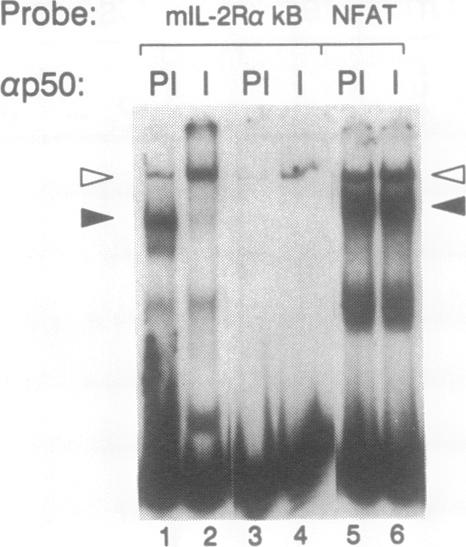
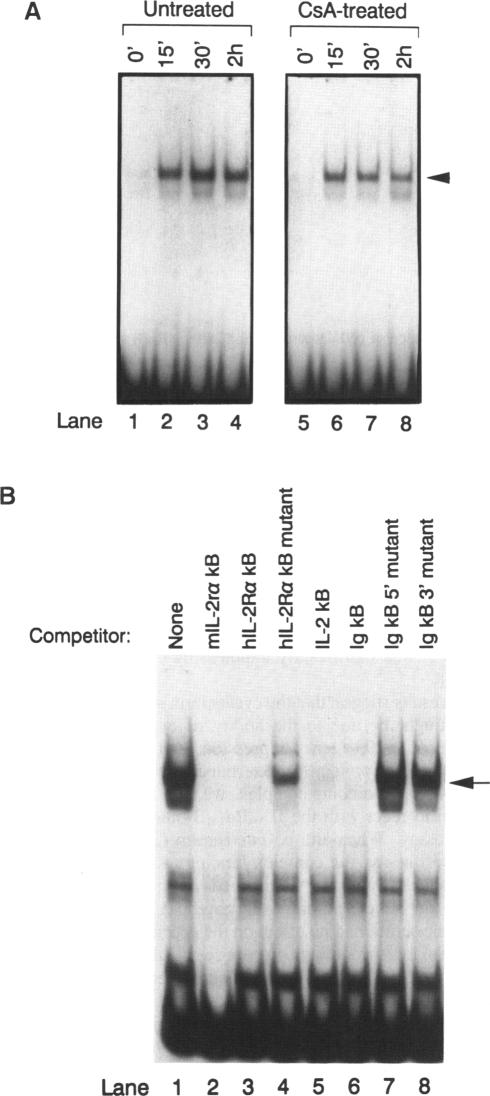
We have investigated the characteristics of IL2R alpha gene induction in untransformed murine T cells. Induction of IL2R alpha mRNA by TCR/CD3 ligands in a murine T cell clone and in short-term splenic T cell cultures was inhibited by protein synthesis inhibitors and by CsA. This result was contrary to previous observations in JURKAT T leukemia cells and human peripheral blood T cells, suggesting a difference in the mechanisms of IL2R alpha gene induction in these different cell types. The CsA sensitivity of IL2R alpha mRNA induction represented a direct effect on the TCR/CD3 response, and was not due to CsA-sensitive release of the lymphokines IL2 or tumour necrosis factor alpha (TNF alpha) and consequent lymphokine-mediated induction of IL2R alpha mRNA. The NF-kappa B site of the IL2R alpha promoter was essential for gene induction through the TCR/CD3 complex, and the induction of reporter plasmids containing multimers of this site was significantly inhibited by CsA. Northern blotting analysis indicated that while the p65 subunit of NF-kappa B was constitutively expressed and not appreciably induced upon T cell activation, mRNA for the p105 precursor of p50 NF-kappa B was induced in response to TCR/CD3 stimulation and this induction was sensitive to CsA. Electrophoretic mobility shift assays and antiserum against the p50 subunit of NF-kappa B indicated that p50 was a component of the inducible nuclear complex that bound to the IL2R alpha kappa B site. Appearance of the kB-binding proteins was insensitive to CsA at early times after activation (approximately 15 min), but was partially sensitive to CsA at later times. Based on these results, we propose that the NF-kappa B site of the IL2R alpha promoter mediates at least part of the CsA sensitivity of IL2R alpha gene induction in untransformed T cells, possibly because de novo synthesis of p105 NF-kappa B is required for sustained IL2R alpha expression.
我们研究了未转化的鼠T细胞中IL2Rα基因诱导的特征。在鼠T细胞克隆和短期脾T细胞培养物中,TCR/CD3配体诱导IL2Rα mRNA的过程受到蛋白质合成抑制剂和环孢素A(CsA)的抑制。这一结果与之前在JURKAT T白血病细胞和人外周血T细胞中的观察结果相反,表明在这些不同细胞类型中IL2Rα基因诱导机制存在差异。IL2Rα mRNA诱导的CsA敏感性代表了对TCR/CD3反应的直接影响,并非由于IL2或肿瘤坏死因子α(TNFα)等细胞因子的CsA敏感释放以及随后细胞因子介导的IL2Rα mRNA诱导。IL2Rα启动子的NF-κB位点对于通过TCR/CD3复合物进行的基因诱导至关重要,并且包含该位点多聚体的报告质粒的诱导受到CsA的显著抑制。Northern印迹分析表明,虽然NF-κB的p65亚基组成性表达且在T细胞活化时没有明显诱导,但p50 NF-κB的p105前体的mRNA在TCR/CD3刺激下被诱导,并且这种诱导对CsA敏感。电泳迁移率变动分析以及针对NF-κB p50亚基的抗血清表明,p50是与IL2Rα κB位点结合的可诱导核复合物的一个组成部分。kB结合蛋白在活化后早期(约15分钟)对CsA不敏感,但在后期对CsA部分敏感。基于这些结果,我们提出IL2Rα启动子的NF-κB位点介导了未转化T细胞中IL2Rα基因诱导的至少部分CsA敏感性,可能是因为持续的IL2Rα表达需要p105 NF-κB的从头合成。