Gibson P, Rosella O, Rosella G, Young G
Department of Medicine, University of Melbourne, Royal Melbourne Hospital, Victoria, Australia.
Gut. 1994 Jul;35(7):969-75. doi: 10.1136/gut.35.7.969.
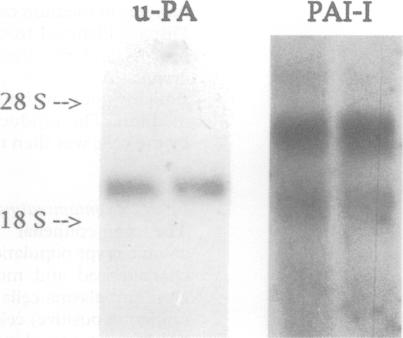
Urokinase is a neutral protease whose major site of action is the external surface of the plasma membrane of cells and whose major function seems to be modulation of cell adhesion, such as that which occurs during cell migration. This study aimed to determine whether colonic epithelium is involved with the urokinase system. The contents of urokinase and one of its specific inhibitors, plasminogen activator inhibitor-1, were measured in culture supernatant and cell homogenates of isolated human colonic crypt cells. The amounts of both factors increased in supernatants over 24 hours, and approximately twice the amount was found in supernatants than in autologous cell homogenates. The secretion of both factors was similar in serum free and serum containing media. Northern blot analysis showed that messenger ribonucleic acid specific for urokinase and plasminogen activator inhibitor-1 was present in colonic crypt cells and that expression over 18 hours of culture was increased 12 fold for urokinase type plasminogen activator and two to fourfold for the inhibitor compared with values found in autologous freshly isolated cells. Urokinase activity was detected in crypt cell homogenates and supernatants indicating that it was present in excess of its inhibitors. Control experiments indicated that the epithelial cells themselves were responsible for the observations and excluded artefactual effects of the isolation procedure. In conclusion, isolated human colonic epithelial cells secrete urokinase and at least one of its specific inhibitors. Further investigation of the role of urokinase in the physiology and pathophysiology of colonic epithelium is indicated.
尿激酶是一种中性蛋白酶,其主要作用位点是细胞膜的外表面,其主要功能似乎是调节细胞黏附,比如在细胞迁移过程中发生的黏附。本研究旨在确定结肠上皮是否与尿激酶系统有关。在分离的人结肠隐窝细胞的培养上清液和细胞匀浆中测量了尿激酶及其一种特异性抑制剂——纤溶酶原激活物抑制剂-1的含量。两种因子的含量在24小时内的上清液中均增加,且在上清液中发现的量约为自体细胞匀浆中的两倍。在无血清和含血清培养基中,两种因子的分泌相似。Northern印迹分析表明,结肠隐窝细胞中存在尿激酶和纤溶酶原激活物抑制剂-1的特异性信使核糖核酸,并且与自体新鲜分离细胞中的值相比,培养18小时后尿激酶型纤溶酶原激活物的表达增加了12倍,抑制剂的表达增加了2至4倍。在隐窝细胞匀浆和上清液中检测到了尿激酶活性,表明其含量超过了抑制剂。对照实验表明,上皮细胞本身导致了这些观察结果,并排除了分离过程的人为影响。总之,分离的人结肠上皮细胞分泌尿激酶及其至少一种特异性抑制剂。提示需要进一步研究尿激酶在结肠上皮生理和病理生理中的作用。