Belgrader P, Maquat L E
Department of Human Genetics, Roswell Park Cancer Institute, Buffalo, New York 14263.
Mol Cell Biol. 1994 Sep;14(9):6326-36. doi: 10.1128/mcb.14.9.6326-6336.1994.
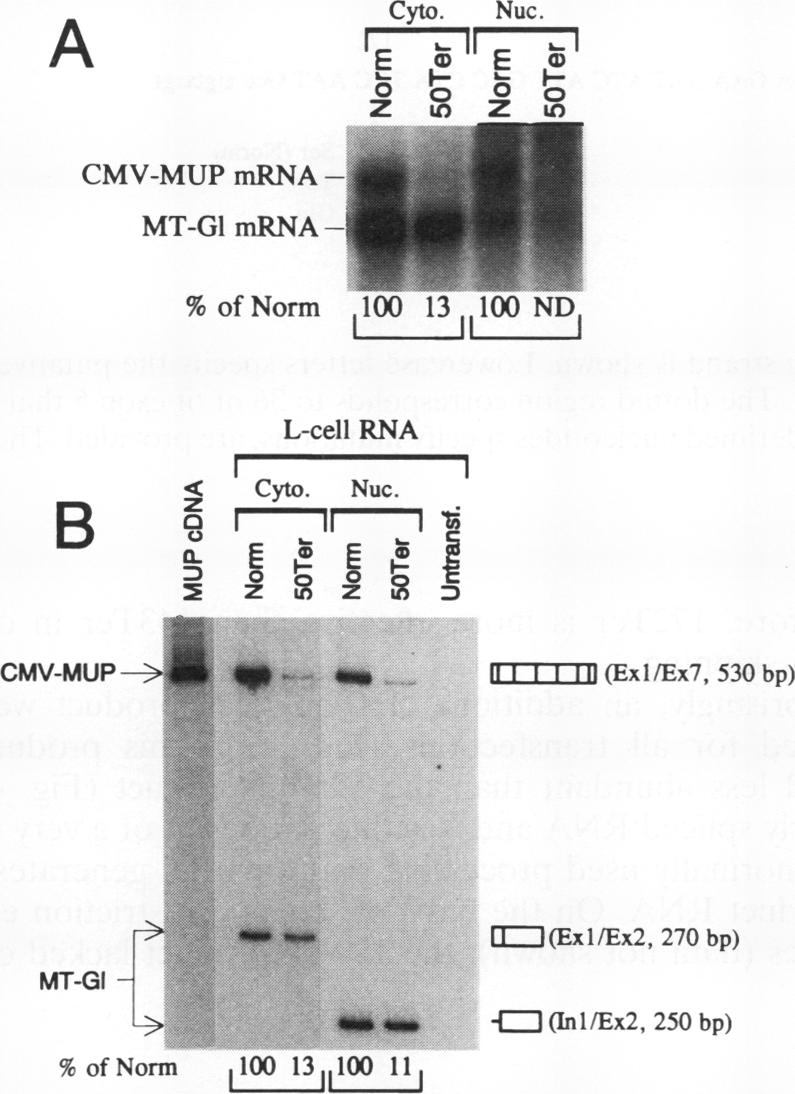
In an effort to understand the mechanisms by which nonsense codons affect RNA metabolism in mammalian cells, nonsense mutations were generated within the gene for the secretory major urinary protein (MUP) of mice. The translation of MUP mRNA normally begins within exon 1 and terminates within exon 6, the penultimate exon. Through the use of Northern (RNA) blot hybridization and assays that couple reverse transcription and PCR, a nonsense mutation within codon 50 of exon 2 or codon 143 of exon 5 was found to reduce the abundance of fully spliced, nuclear MUP mRNA to 10 to 20% of normal without an additional reduction in the abundance of cytoplasmic mRNA. In contrast, a nonsense mutation within codon 172 of exon 5 was found to have no effects on the abundance of MUP mRNA. These findings suggest that a boundary between nonsense mutations that do and do not reduce the abundance of nuclear mRNA exists within the exon preceding the exon that harbors the normal site of translation termination. In this way, the boundary is analogous to the boundary that exists within the penultimate exon of the human gene for the cytosolic enzyme triosephosphate isomerase. Assays for exon skipping, i.e., the removal of an exon as a part of the flanking introns during the process of splicing, reveal that 0.1, 2.0, and 0.1% of MUP mRNA normally lack exon 5, exon 6, and exons 5 plus 6, respectively. Relative to normal, the two nonsense mutations within exon 5 increase the abundance of RNA lacking exon 5 on average 20-fold and increase the abundance of RNA lacking exons 5 plus 6 on average 5-fold. Since only one of these nonsense mutations also reduces the abundance of fully spliced nuclear mRNA to 10 to 20% of normal, the two mechanisms by which a nonsense mutation can alter nuclear RNA metabolism must be distinct. The analysis of missense mutations within codons 143 and 172, some of which retain the nonsense mutation, indicates that the reduction in the abundance of fully spliced nuclear mRNA is dependent upon the premature termination of MUP mRNA translation, whereas skipping is attributable to nonsense mutation-mediated changes in exon 5 structure rather than to the premature termination of translation. The increase in exon 5 skipping by either the nonsense or missense mutations within codon 172 correlates with a decrease in the complementarity of exon 5 to U1 snRNA. This suggests that a 5' splice site may extend as far as 12 nucleotides into the upstream exon, which is, to our knowledge, the largest extension.
为了了解无义密码子影响哺乳动物细胞中RNA代谢的机制,在小鼠分泌性主要尿蛋白(MUP)基因内产生了无义突变。MUP mRNA的翻译通常在外显子1内起始,并在内含子倒数第二个外显子6内终止。通过Northern(RNA)印迹杂交以及逆转录与PCR联用的检测方法,发现外显子2的第50密码子或外显子5的第143密码子处的无义突变可使完全剪接的核MUP mRNA丰度降低至正常水平的10%至20%,而细胞质mRNA丰度并未进一步降低。相比之下,发现外显子5的第172密码子处的无义突变对MUP mRNA丰度没有影响。这些发现表明,在含有正常翻译终止位点的外显子之前的外显子内,存在着能降低和不能降低核mRNA丰度的无义突变之间的界限。这样,该界限类似于人类胞质酶磷酸丙糖异构酶基因倒数第二个外显子内存在的界限。外显子跳跃检测,即在外显子剪接过程中作为侧翼内含子的一部分去除外显子,结果显示正常情况下分别有0.1%、2.0%和0.1%的MUP mRNA缺少外显子5、外显子6以及外显子5加外显子6。相对于正常情况,外显子5内的两个无义突变使缺少外显子5的RNA丰度平均增加20倍,使缺少外显子5加外显子6的RNA丰度平均增加5倍。由于这些无义突变中只有一个也将完全剪接的核mRNA丰度降低至正常水平的10%至20%,因此无义突变改变核RNA代谢的两种机制必然不同。对第143和172密码子内错义突变(其中一些保留了无义突变)的分析表明,完全剪接的核mRNA丰度的降低取决于MUP mRNA翻译的提前终止,而跳跃则归因于无义突变介导的外显子5结构变化,而非翻译的提前终止。第172密码子处的无义或错义突变导致的外显子5跳跃增加与外显子5与U1 snRNA互补性的降低相关。这表明5'剪接位点可能向上游外显子延伸多达12个核苷酸,据我们所知,这是最大的延伸长度。