Nickless Andrew, Bailis Julie M, You Zhongsheng
Department of Cell Biology & Physiology, Washington University School of Medicine, Campus Box 8228, 660 S. Euclid Ave., St. Louis, MO 63110 USA.
Department of Oncology Research, Amgen, South San Francisco, CA 94080 USA.
Cell Biosci. 2017 May 19;7:26. doi: 10.1186/s13578-017-0153-7. eCollection 2017.
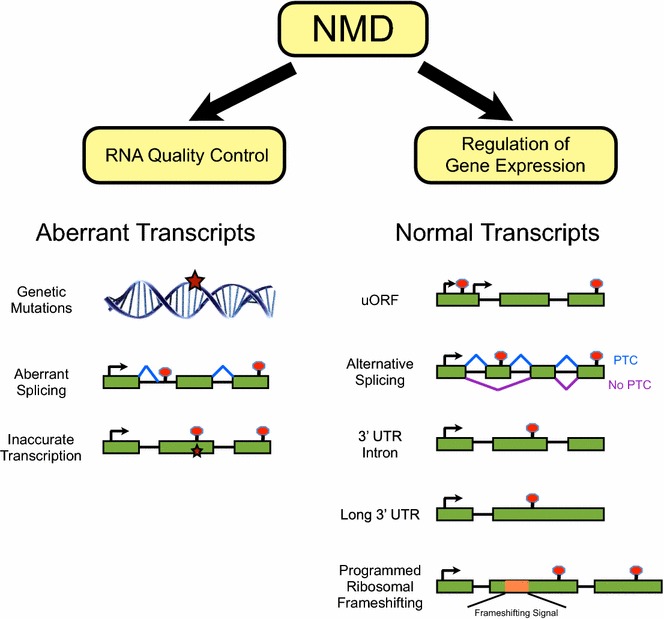
Nonsense-mediated RNA decay (NMD) was originally discovered as a cellular surveillance pathway that safeguards the quality of mRNA transcripts in eukaryotic cells. In its canonical function, NMD prevents translation of mutant mRNAs harboring premature termination codons (PTCs) by targeting them for degradation. However, recent studies have shown that NMD has a much broader role in gene expression by regulating the stability of many normal transcripts. In this review, we discuss the function of NMD in normal physiological processes, its dynamic regulation by developmental and environmental cues, and its association with human disease.
无义介导的RNA降解(NMD)最初被发现是一种细胞监测途径,可保障真核细胞中信使核糖核酸(mRNA)转录本的质量。在其典型功能中,NMD通过将携带提前终止密码子(PTC)的突变mRNA靶向降解,从而阻止其翻译。然而,最近的研究表明,NMD通过调节许多正常转录本的稳定性,在基因表达中发挥着更为广泛的作用。在这篇综述中,我们讨论了NMD在正常生理过程中的功能、其受发育和环境信号的动态调控,以及它与人类疾病的关联。