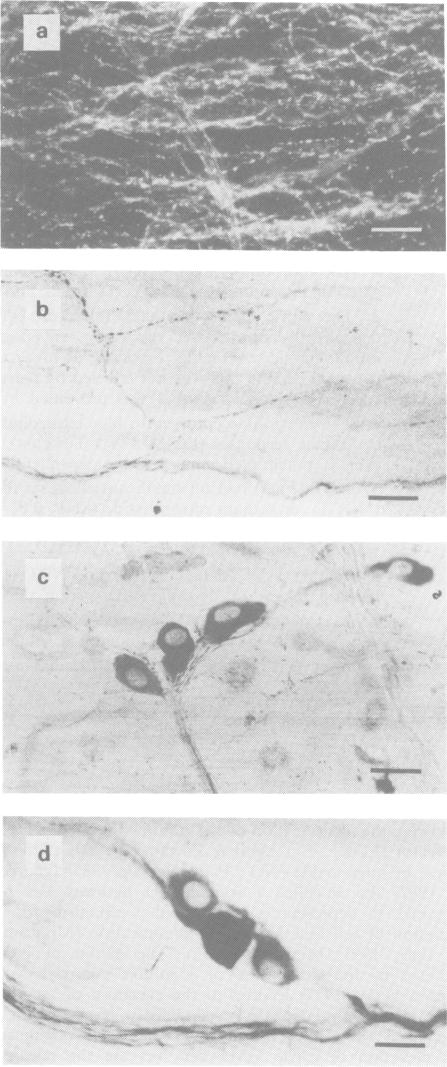
The distribution of NADPH-diaphorase positive and catecholamine-containing nerve structures, and functional noradrenergic-nitrergic interactions, were studied in the rat anococcygeus muscle. 2. The morphological findings demonstrated NADPH-diaphorase positive neurons mostly as aggregates in intramural ganglia, nerve tracts and few single nerve fibres forming plexus-like structures. 3. The nitric oxide synthase inhibitor NG-nitro-L-arginine (L-NOARG) inhibited concentration-dependently the nitrergic relaxation, an effect reversed by L-arginine. The drug had dual effects on noradrenergic contractile responses: at lower concentrations (0.1-10 microM) it decreased the amplitude of contractions and this was not affected by L-arginine; higher concentrations (50-500 microM) potentiated the contractions, an effect that was prevented by L-arginine. 4. The electron acceptor, nitro blue tetrazolium (NBT) produced a rapid inhibition of the noradrenergic contractile responses (EC50 0.178 +/- 0.041 microM). The drug decreased the tone of the preparations. However, it potentiated concentration-dependently the nitrergic relaxations. 5. NBT (1 microM) had no significant effect on the relaxations induced by exogenously applied nitric oxide (NO)-donor sodium nitroprusside (SNP, 0.01-50 microM). However, the effect of NBT (0.1-10 microM) on the electrically induced relaxation was significantly decreased by L-NOARG (10 and 50 microM). The inhibition was of a non-competitive type. 6. Neither L-NOARG (100 microM) nor NBT (1 microM) had any effect on the spontaneous or electrically-induced release of 3H-radioactivity from the tissues preincubated in [3H]-noradrenaline. 7. It is concluded that L-arginine-NO pathway can modulate noradrenergic transmission in the rat anococcygeus muscle at postjunctional, but not prejunctional site(s).