Adams D O
Am J Pathol. 1975 Jul;80(1):101-16.
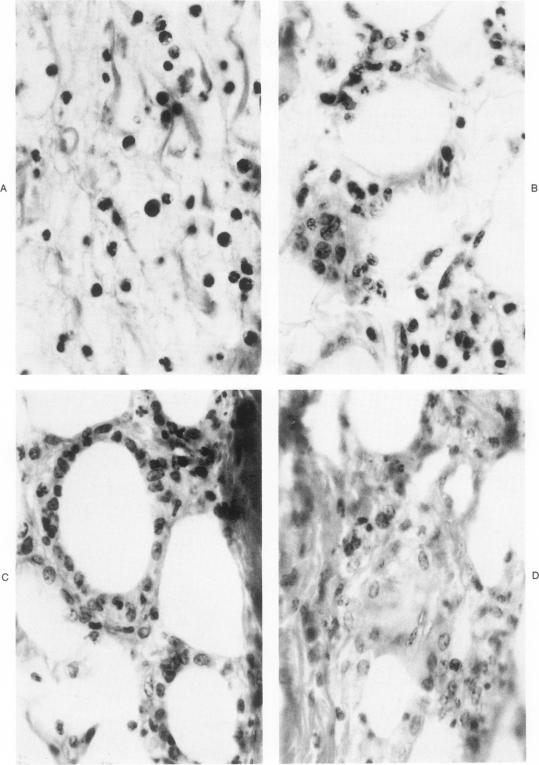
The development and resolution of granulomas induced by Mycobacterium tuberculosis were sequentially traced by correlated light and electron microscopy. The scattered, immature monocytes initially composing the lesions evolved by orderly steps into coalescent, well developed macrophages and ultimately into swirling nests of highly complex epithelioid cells. These ultrastructural changes represent differentiation in vivo of the mononuclear phagocytes. The number of mycobacteria present than waned markedly, and the epithelioid granulomas developed into foreign body granulomas and finally into simple chronic inflammation. Concmonitantly, the epithelioid cells evolved into macrophages and ultimately into immature, monocyte-like forms. These observations suggest that the development of a granuloma represents differntiation in vivo of the constituent mononuclear phagocytes in response to an evoking stimulus. From comparisons with previous studies, mononuclear differentiation in vivo appears to have a fixed pattern and a markedly alterable pace. The observations also suggest a previously undescribed fate for mononuclear phagocytes in developing granulomas. As the granuloma-evoking agent is destroyed, the highly differentiated mononuclear phagocytes change into less mature forms.
通过相关的光学显微镜和电子显微镜对结核分枝杆菌诱导的肉芽肿的发展和消退进行了连续追踪。最初构成病变的散在、未成熟单核细胞按有序步骤演变为融合的、发育良好的巨噬细胞,最终演变为高度复杂的上皮样细胞的漩涡状巢。这些超微结构变化代表了单核吞噬细胞在体内的分化。随后存在的分枝杆菌数量明显减少,上皮样肉芽肿发展为异物肉芽肿,最终发展为单纯性慢性炎症。与此同时,上皮样细胞演变为巨噬细胞,最终演变为未成熟的、单核细胞样形态。这些观察结果表明,肉芽肿的发展代表了组成单核吞噬细胞在体内对诱发刺激的分化。通过与先前研究的比较,体内单核细胞分化似乎有固定模式和明显可变的速度。这些观察结果还提示了发育中的肉芽肿中单核吞噬细胞以前未描述的命运。随着肉芽肿诱发剂被破坏,高度分化的单核吞噬细胞转变为不太成熟的形式。