Ravanello M P, Hruby D E
Department of Microbiology, Oregon State University, Corvallis 97331-3804.
J Virol. 1994 Oct;68(10):6401-10. doi: 10.1128/JVI.68.10.6401-6410.1994.
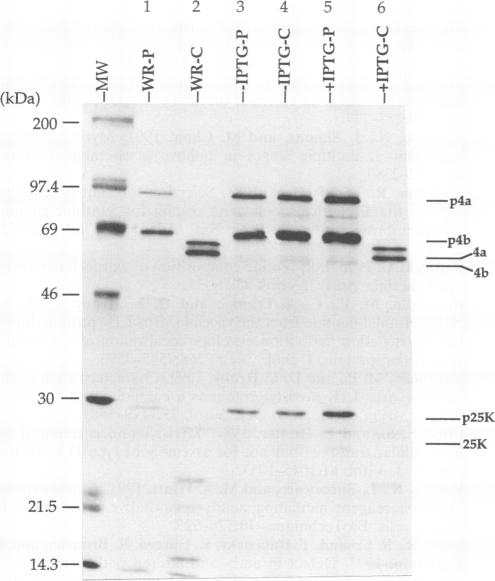
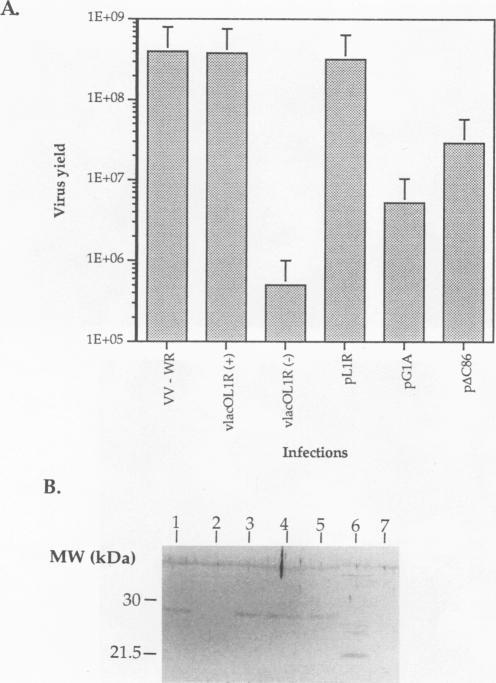
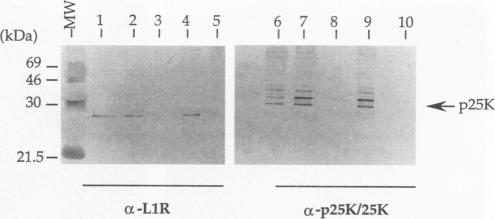
Within vaccinia virus-infected cells, the product of the L1R open reading frame is covalently modified by myristic acid at the penultimate NH2-terminal glycine residue. Previously we have shown that while the L1R protein is a constituent of both intracellular mature virus particles and extracellular enveloped virions which are released from the infected cell, it is associated exclusively with the primary membranes surrounding the virion core. Given this rather specific localization, it was of interest to study the potential role of this essential gene in virus replication and morphogenesis. To this end, we have constructed a recombinant vaccinia virus in which expression of the L1R gene can be transcriptionally repressed. Without the inducer isopropylthiogalactopyranoside (IPTG), synthesis of the L1R protein was blocked, resulting in a total inhibition of plaque formation. Velocity sedimentation of viral particles labeled in the presence of [3H]thymidine, grown in the absence of IPTG, revealed a substantial reduction in viral DNA incorporation into virions. Likewise, proteolysis of the major core proteins p4a, p4b, and p25K, believed to occur during the final stages of virion maturation, was severely impaired. In the absence of L1R expression, only immature virions could be detected by electron microscopy. Transient expression of a plasmid containing the full-length L1R gene driven by its own promoter was able to complement and rescue the defective phenotype. However, a plasmid bearing a mutation in the myristyl acceptor glycine residue was unable to biologically rescue the recombinant, and the protein was not detected in purified virions.trans complementation using a truncated, myristylated form of the L1R protein partially rescued the defective mutant. Collectively, these data suggest that myristic acid mediates essential interactions of the L1R protein with viral membranes and/or other virion components that lead to the productive assembly, maturation, and release of particles.
在感染痘苗病毒的细胞内,L1R开放阅读框的产物在倒数第二个NH2末端甘氨酸残基处被肉豆蔻酸共价修饰。此前我们已经表明,虽然L1R蛋白是细胞内成熟病毒颗粒和从感染细胞释放的细胞外被膜病毒粒子的组成成分,但它仅与围绕病毒粒子核心的初级膜相关。鉴于这种相当特异的定位,研究这个必需基因在病毒复制和形态发生中的潜在作用就很有意义。为此,我们构建了一种重组痘苗病毒,其中L1R基因的表达可以被转录抑制。在没有诱导剂异丙基硫代半乳糖苷(IPTG)的情况下,L1R蛋白的合成被阻断,导致蚀斑形成完全受到抑制。在没有IPTG的情况下生长并在[3H]胸苷存在下标记的病毒粒子的速度沉降显示,病毒DNA掺入病毒粒子的量大幅减少。同样,据信在病毒粒子成熟的最后阶段发生的主要核心蛋白p4a、p4b和p25K的蛋白水解也严重受损。在没有L1R表达的情况下,通过电子显微镜只能检测到未成熟的病毒粒子。由其自身启动子驱动的含有全长L1R基因的质粒的瞬时表达能够互补并挽救缺陷表型。然而,在肉豆蔻酰接受体甘氨酸残基处带有突变的质粒无法从生物学上挽救重组体,并且在纯化的病毒粒子中未检测到该蛋白。使用截短的、肉豆蔻酰化形式的L1R蛋白进行反式互补部分挽救了缺陷突变体。总的来说,这些数据表明肉豆蔻酸介导了L1R蛋白与病毒膜和/或其他病毒粒子成分的必需相互作用,这些相互作用导致了粒子的有效组装、成熟和释放。