Chiou S K, Tseng C C, Rao L, White E
Center for Advanced Biotechnology and Medicine, Rutgers University, Piscataway, New Jersey 08854.
J Virol. 1994 Oct;68(10):6553-66. doi: 10.1128/JVI.68.10.6553-6566.1994.
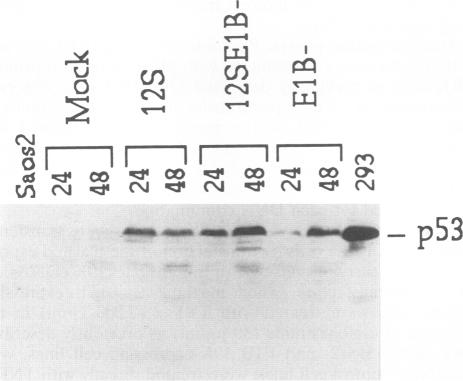
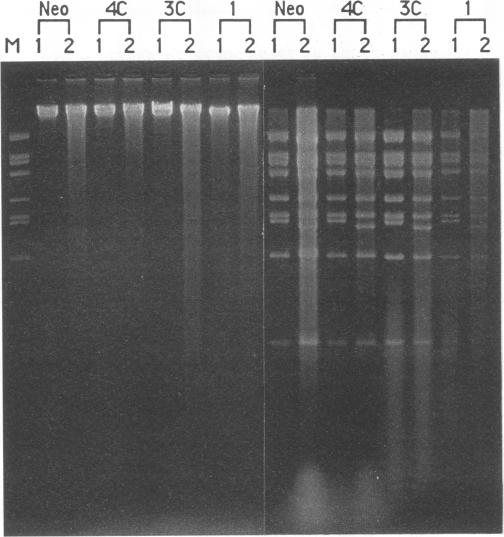
Expression of the adenovirus E1A oncogene induces apoptosis which impedes both the transformation of primary rodent cells and productive adenovirus infection of human cells. Coexpression of E1A with the E1B 19,000-molecular-weight protein (19K protein) or the Bcl-2 protein, both of which have antiapoptotic activity, is necessary for efficient transformation. Induction of apoptosis by E1A in rodent cells is mediated by the p53 tumor suppressor gene, and both the E1B 19K protein and the Bcl-2 protein can overcome this p53-dependent apoptosis. The functional similarity between Bcl-2 and the E1B 19K protein suggested that they may act by similar mechanisms and that Bcl-2 may complement the requirement for E1B 19K expression during productive infection. Infection of human HeLa cells with E1B 19K loss-of-function mutant adenovirus produces apoptosis characterized by enhanced cytopathic effects (cyt phenotype) and degradation of host cell chromosomal DNA and viral DNA (deg phenotype). Failure to inhibit apoptosis results in premature host cell death, which impairs virus yield. HeLa cells express extremely low levels of p53 because of expression of human papillomavirus E6 protein. Levels of p53 were substantially increased by E1A expression during adenovirus infection. Therefore, E1A may induce apoptosis by overriding the E6-induced degradation of p53 and promoting p53 accumulation. Stable Bcl-2 overexpression in HeLa cells infected with the E1B 19K- mutant adenovirus blocked the induction of the cyt and deg phenotypes. Expression of Bcl-2 in HeLa cells also conferred resistance to apoptosis mediated by tumor necrosis factor alpha and Fas antigen, which is also an established function of the E1B 19K protein. A comparison of the amino acid sequences of Bcl-2 family members and that of the E1B 19K protein indicated that there was limited amino acid sequence homology between the central conserved domains of E1B 19K and Bcl-2. This domain of the E1B 19K protein is important in transformation and regulation of apoptosis, as determined by mutational analysis. The limited sequence homology and functional equivalency provided further evidence that the Bcl-2 and E1B 19K proteins may possess related mechanisms of action and that the E1B 19K protein may be the adenovirus equivalent of the cellular Bcl-2 protein.
腺病毒E1A癌基因的表达可诱导细胞凋亡,这既阻碍了原代啮齿动物细胞的转化,也阻碍了人类细胞中腺病毒的有效感染。E1A与具有抗凋亡活性的E1B 19000分子量蛋白(19K蛋白)或Bcl-2蛋白共表达,对于有效转化是必需的。E1A在啮齿动物细胞中诱导的细胞凋亡由p53肿瘤抑制基因介导,E1B 19K蛋白和Bcl-2蛋白都可以克服这种p53依赖性细胞凋亡。Bcl-2与E1B 19K蛋白之间的功能相似性表明它们可能通过相似的机制发挥作用,并且Bcl-2可能在有效感染期间补充对E1B 19K表达的需求。用E1B 19K功能丧失突变型腺病毒感染人类HeLa细胞会产生细胞凋亡,其特征为细胞病变效应增强(细胞表型)以及宿主细胞染色体DNA和病毒DNA降解(降解表型)。无法抑制细胞凋亡会导致宿主细胞过早死亡,从而损害病毒产量。由于人乳头瘤病毒E6蛋白的表达,HeLa细胞中p53的表达水平极低。在腺病毒感染期间,E1A的表达使p53水平大幅增加。因此,E1A可能通过克服E6诱导的p53降解并促进p53积累来诱导细胞凋亡。在感染E1B 19K突变型腺病毒的HeLa细胞中稳定过表达Bcl-2可阻断细胞和降解表型的诱导。在HeLa细胞中表达Bcl-2还赋予了对肿瘤坏死因子α和Fas抗原介导的细胞凋亡的抗性,这也是E1B 19K蛋白已确立的功能。对Bcl-2家族成员与E1B 19K蛋白的氨基酸序列进行比较表明,E1B 19K与Bcl-2的中央保守结构域之间的氨基酸序列同源性有限。通过突变分析确定,E1B 19K蛋白的该结构域在转化和细胞凋亡调控中很重要。有限的序列同源性和功能等效性提供了进一步的证据,表明Bcl-2和E1B 19K蛋白可能具有相关的作用机制,并且E1B 19K蛋白可能是细胞Bcl-2蛋白的腺病毒等效物。