Shapira M, Seidman S, Sternfeld M, Timberg R, Kaufer D, Patrick J, Soreq H
Department of Biological Chemistry, Hebrew University, Jerusalem, Israel.
Proc Natl Acad Sci U S A. 1994 Sep 13;91(19):9072-6. doi: 10.1073/pnas.91.19.9072.
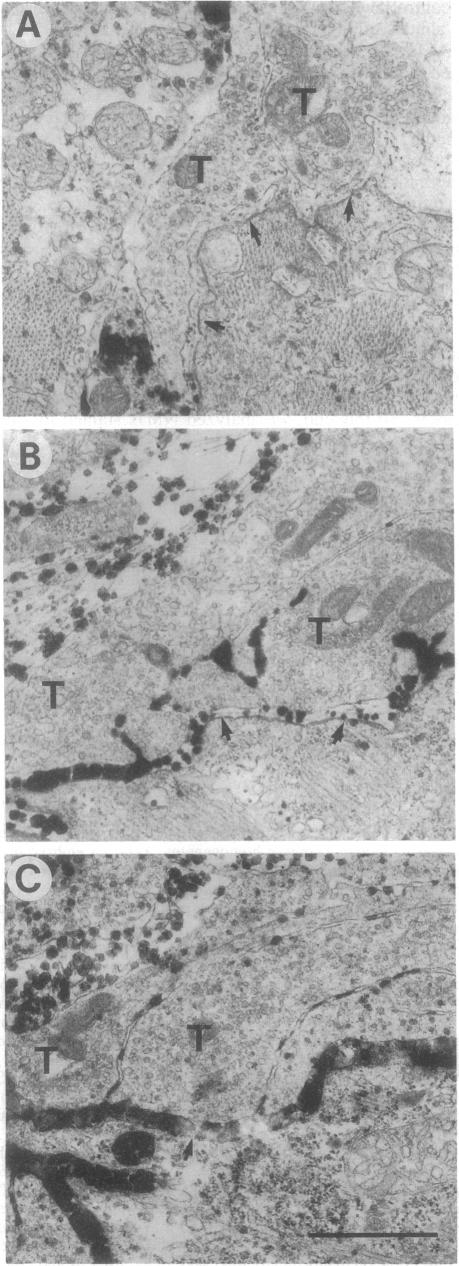
To examine the role of key cholinergic proteins in the formation of neuromuscular junctions (NMJs), we expressed DNAs encoding the mouse muscle nicotinic acetylcholine receptor (nAChR) or human brain and muscle acetylcholinesterase (hAChE) in developing Xenopus laevis embryos. Acetylthiocholine hydrolysis and alpha-bungarotoxin binding in homogenates of transgenic embryos revealed transient overexpression of the respective proteins for at least 4 days postfertilization. Moreover, hAChE injection induced an approximately 2-fold increase in endogenous Xenopus nAChR. Electron microscopy coupled with cytochemical staining for AChE activity revealed that AChE-stained areas, which reached 0.17 microns2 in NMJs of control embryos raised at 21 degrees C, increased up to 0.53 and 0.60 microns2 in nAChR and hAChE transgenics, respectively. These increases coincided with the appearance of a class of large NMJs with average postsynaptic lengths up to 1.8-fold greater than controls. As much as 57% and 34% of the NMJs in animals transgenic for nAChR and hAChE, respectively, displayed AChE activity in nerve terminals in addition to muscle labeling, as compared with 10% nerve-labeled NMJs in control animals. Moreover, area, but not length values, were > 2-fold larger in hAChE-expressing NMJs labeled in their nerve terminals than in those labeled in muscle alone, reflecting a hAChE-induced increase in synaptic cleft width. These findings indicate that modulation of cholinergic neurotransmission in NMJs modifies the features of nerve-muscle connections.
为了研究关键胆碱能蛋白在神经肌肉接头(NMJ)形成中的作用,我们在非洲爪蟾胚胎发育过程中表达了编码小鼠肌肉烟碱型乙酰胆碱受体(nAChR)或人脑及肌肉乙酰胆碱酯酶(hAChE)的DNA。转基因胚胎匀浆中的乙酰硫代胆碱水解和α-银环蛇毒素结合显示,受精后至少4天内相应蛋白有短暂的过表达。此外,注射hAChE导致非洲爪蟾内源性nAChR增加约2倍。电子显微镜结合AChE活性的细胞化学染色显示,在21℃饲养的对照胚胎的NMJ中,AChE染色区域面积为0.17平方微米,在nAChR和hAChE转基因胚胎中分别增加到0.53和0.60平方微米。这些增加与一类大的NMJ的出现相吻合,其平均突触后长度比对照长1.8倍。与对照动物中10%的神经标记NMJ相比,nAChR转基因动物和hAChE转基因动物中分别有多达57%和34%的NMJ除了肌肉标记外,神经末梢也显示AChE活性。此外,hAChE表达的NMJ中神经末梢标记的区域面积而非长度值比仅肌肉标记的区域大2倍以上,这反映了hAChE诱导的突触间隙宽度增加。这些发现表明,NMJ中胆碱能神经传递的调节改变了神经肌肉连接的特征。