Chen M K, Espat N J, Bland K I, Copeland E M, Souba W W
Department of Surgery, University of Florida College of Medicine, Gainesville.
Ann Surg. 1993 Jun;217(6):655-66; discussion 666-7. doi: 10.1097/00000658-199306000-00007.
The effects of progressive malignant growth on glutamine metabolism in skeletal muscle and in kidney were investigated.
Fast-growing tumors consume considerable quantities of glutamine and lead to a decrease in circulating glutamine concentrations.
Experiments were performed at various stages of tumor growth in rats implanted subcutaneously with the non-metastasizing methylcholanthrene-induced (MCA) fibrosarcoma and in pair-fed non tumor-bearing controls.
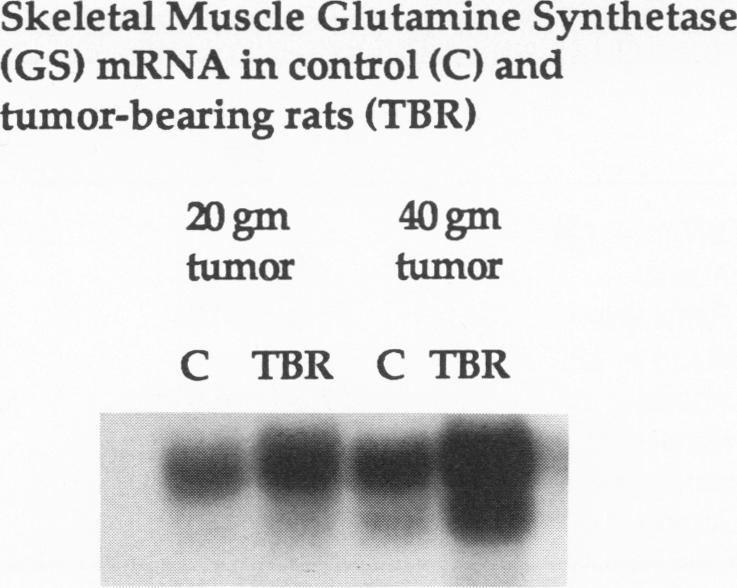
Tumor growth stimulated a twofold increase in hindquarter (muscle) glutamine release, which was not due to an increase in blood flow, but rather to a doubling in the fractional release rate. Consequently, a progressive decrease in skeletal muscle glutamine concentrations was observed over time. Simultaneously, the activity of glutamine synthetase (GS), the principal enzyme of de novo glutamine biosynthesis, increased more than twofold. This increase in muscle GS activity was accompanied by an increase in GS mRNA but the augmentation in GS expression apparently could not match the increased rate of efflux since muscle depletion developed. In rats with large tumors and severe glutamine depletion, GS activity was not elevated. Glutamine feeding increased muscle glutamine concentrations and glutamine synthetase specific activity. Although tumor growth led to the development of mild systemic acidemia, the classic renal adaptations normally observed, i.e., elevated glutaminase activity and accelerated renal glutamine utilization, were not present in acidotic tumor-bearing rats. Instead, renal GS activity was increased in tumor-bearing animals and ammoniagenesis was enhanced, in spite of a reduction in net renal glutamine uptake.
These data suggest that marked alterations in muscle and renal glutamine handling occur in the host with cancer; the enhanced muscle glutamine release in conjunction with no increase in renal consumption is consistent with increased glutamine uptake in other organs, most likely the tumor itself and the liver.
研究进行性恶性生长对骨骼肌和肾脏中谷氨酰胺代谢的影响。
快速生长的肿瘤消耗大量谷氨酰胺,并导致循环中谷氨酰胺浓度降低。
在皮下植入非转移性甲基胆蒽诱导(MCA)纤维肉瘤的大鼠肿瘤生长的各个阶段进行实验,并设置成对喂养的无肿瘤对照。
肿瘤生长刺激后肢(肌肉)谷氨酰胺释放增加两倍,这不是由于血流量增加,而是由于分数释放率翻倍。因此,随着时间的推移,观察到骨骼肌谷氨酰胺浓度逐渐降低。同时,从头合成谷氨酰胺的主要酶谷氨酰胺合成酶(GS)的活性增加了两倍多。肌肉GS活性的增加伴随着GS mRNA的增加,但由于肌肉消耗的发展,GS表达的增加显然无法与增加的流出率相匹配。在患有大肿瘤和严重谷氨酰胺消耗的大鼠中,GS活性没有升高。补充谷氨酰胺可增加肌肉谷氨酰胺浓度和谷氨酰胺合成酶比活性。尽管肿瘤生长导致轻度全身酸血症的发生,但在酸中毒的荷瘤大鼠中,通常观察到的经典肾脏适应性变化,即谷氨酰胺酶活性升高和肾脏谷氨酰胺利用加速,并未出现。相反,荷瘤动物的肾脏GS活性增加,氨生成增强,尽管肾脏谷氨酰胺净摄取减少。
这些数据表明,癌症宿主的肌肉和肾脏中谷氨酰胺处理发生了显著改变;肌肉谷氨酰胺释放增加而肾脏消耗没有增加,这与其他器官(很可能是肿瘤本身和肝脏)谷氨酰胺摄取增加一致。