Sambrano G R, Parthasarathy S, Steinberg D
Department of Medicine, University of California at San Diego, La Jolla 92093-0682.
Proc Natl Acad Sci U S A. 1994 Apr 12;91(8):3265-9. doi: 10.1073/pnas.91.8.3265.
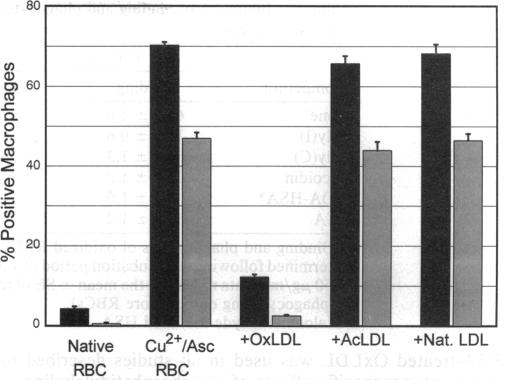
Macrophages specifically bind and internalize oxidatively modified low density lipoprotein (LDL) via the acetyl-LDL receptor and possibly one or more additional receptors jointly designated here as scavenger receptors. It is well accepted that these receptors are intimately involved in the formation of foam cells during atherogenesis. However, the normal physiological or pathophysiological role for these receptors has not been established. Oxidation of plasma membranes is a common accompaniment of cell damage and senescence. In particular, aged erythrocytes demonstrate peroxidation of their cell membrane lipids. In the present studies we show that oxidized human erythrocytes (treated with copper plus ascorbate or hydrogen peroxide) are bound and phagocytosed by mouse peritoneal macrophages in the absence of opsonizing antibodies. There was little or no binding of untreated erythrocytes. Oxidized LDL, but not acetylated or native LDL, inhibited this binding and uptake of oxidized erythrocytes. Inhibitors of scavenger receptor binding, including polyinosinic acid and fucoidin, also prevented binding of the oxidized red blood cells. We suggest that oxidative damage of erythrocytes results in the formation of lipid-protein conjugate(s) closely related to some of the conjugates found in oxidized LDL, making the oxidized erythrocyte a ligand for the macrophage scavenger receptors, apparently at a site distinct from that responsible for the binding of acetylated LDL. Oxidative modification of plasma membranes may represent a general mechanism that marks damaged cells for phagocytosis by macrophages.
巨噬细胞通过乙酰化低密度脂蛋白受体以及可能的一种或多种其他受体(在此统称为清道夫受体)特异性地结合并内化氧化修饰的低密度脂蛋白(LDL)。人们普遍认为,这些受体在动脉粥样硬化形成过程中与泡沫细胞的形成密切相关。然而,这些受体的正常生理或病理生理作用尚未明确。质膜氧化是细胞损伤和衰老的常见伴随现象。特别是衰老的红细胞表现出其细胞膜脂质的过氧化。在本研究中,我们发现氧化的人红细胞(用铜加抗坏血酸或过氧化氢处理)在没有调理素抗体的情况下被小鼠腹腔巨噬细胞结合并吞噬。未处理的红细胞几乎没有或根本没有结合。氧化型LDL而非乙酰化或天然LDL抑制了氧化红细胞的这种结合和摄取。清道夫受体结合抑制剂,包括聚肌苷酸和岩藻依聚糖,也阻止了氧化红细胞的结合。我们认为,红细胞的氧化损伤导致形成与氧化型LDL中发现的一些缀合物密切相关的脂质 - 蛋白质缀合物,使氧化红细胞成为巨噬细胞清道夫受体的配体,显然是在一个与负责乙酰化LDL结合的位点不同的位点。质膜的氧化修饰可能代表一种普遍机制,该机制标记受损细胞以便被巨噬细胞吞噬。