Zerrahn J, Knippschild U, Winkler T, Deppert W
Heinrich-Pette-Institut für Experimentelle Virologie und Immunologie, Universität Hamburg, Germany.
EMBO J. 1993 Dec;12(12):4739-46. doi: 10.1002/j.1460-2075.1993.tb06162.x.
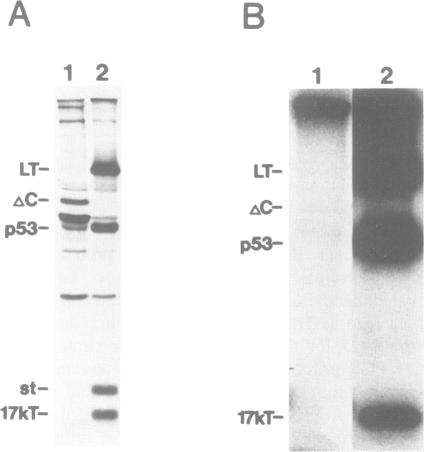
We found that simian virus 40 (SV40), in addition to the SV40 early proteins large T antigen (large T) and small antigen (small t), codes for a third early protein with a molecular weight of 17 kDa. This protein (17kT) is expressed from an alternatively spliced third SV40 early mRNA, using a splice donor site at position 4425 and a splice acceptor site at position 3679 of the SV40 genome. The 17kT protein consists of 135 amino acids. Of these, 131 correspond to the amino-terminus of large T, while the four carboxy-terminal amino acids are unique and encoded by a different reading frame. 17kT mRNA, and the corresponding protein, were found in all SV40 transformed cells analyzed, as well as in SV40 infected cells. Transfection of a cDNA expression vector encoding the 17kT protein into rat F111 fibroblasts induced phenotypic transformation of these cells. The expression of the transforming amino-terminal domain of large T as an independent 17kT protein might provide a means for individually regulating the various functions associated with this domain.
我们发现,猿猴病毒40(SV40)除了编码SV40早期蛋白大T抗原(大T)和小抗原(小t)外,还编码一种分子量为17 kDa的第三种早期蛋白。这种蛋白(17kT)由一个选择性剪接的第三种SV40早期mRNA表达,使用SV40基因组中第4425位的剪接供体位点和第3679位的剪接受体位点。17kT蛋白由135个氨基酸组成。其中,131个氨基酸对应大T的氨基末端,而四个羧基末端氨基酸是独特的,由不同的阅读框编码。在所有分析的SV40转化细胞以及SV40感染细胞中都发现了17kT mRNA和相应的蛋白。将编码17kT蛋白的cDNA表达载体转染到大鼠F111成纤维细胞中可诱导这些细胞发生表型转化。将大T的转化性氨基末端结构域作为独立的17kT蛋白表达可能为单独调节与该结构域相关的各种功能提供一种手段。