Cheung P H, Culic O, Qiu Y, Earley K, Thompson N, Hixson D C, Lin S H
Department of Molecular Pathology, University of Texas M.D. Anderson Cancer Center, Houston 77030.
Biochem J. 1993 Oct 15;295 ( Pt 2)(Pt 2):427-35. doi: 10.1042/bj2950427.
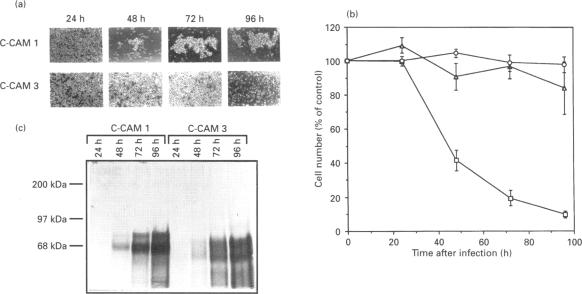
Cell-CAM105 (also named C-CAM) is a cell surface glycoprotein involved in intercellular adhesion of rat hepatocytes. It has four extracellular immunoglobulin (Ig) domains, a transmembrane domain and a cytoplasmic domain and therefore is a member of the Ig supergene family. We have characterized multiple cDNAs of the C-CAM genes in rat intestine. Sequence analyses showed that rat intestine contained not only the previously reported L-form and S-form C-CAMs (renamed C-CAM1 and C-CAM2 respectively) but also a new isoform, C-CAM3. The C-CAM3 transcript codes for a polypeptide with a truncated C-terminus that lacks 65 amino acids from the previously reported C-CAM1 cytoplasmic domain. Unlike C-CAM1, C-CAM3 did not mediate cell adhesion when expressed in insect cells using the baculoviral expression system. Thus the extra 65 amino acids in the cytoplasmic domain of C-CAM1 are important for adhesion phenotype when expressed in insect cells. Although C-CAM1 and C-CAM2 are encoded by different genes, sequence analysis suggests that C-CAM3 is probably derived from alternative splicing of the C-CAM1 gene. To examine this possibility, we have determined the exon organization of the C-CAM1 gene. C-CAM3 differed from C-CAM1 by the presence of a single unspliced intron which contained a stop codon immediately after the regular splice junction. As a result, translation of C-CAM3 terminates at the point where C-CAM1 and C-CAM3 sequences diverge. To investigate the expression of C-CAM1, C-CAM2 and C-CAM3 in different tissues, we used an RNAase-protection assay to simultaneously assess the levels of expression of these transcripts. Using total RNA prepared from various tissues, we showed that expression of C-CAM3 was tissue-specific, and the C-CAM3 transcript accounted for about 25% of the transcripts derived from the C-CAM1 gene. However, further analysis revealed that C-CAM3 transcript was not present in cytosolic RNA, rather it was enriched in nuclear RNA prepared from hepatocytes. Although C-CAM3 cDNA contains the polyadenylation signal and is polyadenylated, these results indicate that C-CAM3 is probably an incomplete spliced product of C-CAM1 gene.
细胞黏附分子105(也称为C-CAM)是一种参与大鼠肝细胞间黏附的细胞表面糖蛋白。它有四个细胞外免疫球蛋白(Ig)结构域、一个跨膜结构域和一个细胞质结构域,因此是Ig超基因家族的成员。我们已经对大鼠肠道中C-CAM基因的多个cDNA进行了表征。序列分析表明,大鼠肠道中不仅含有先前报道的L型和S型C-CAMs(分别重新命名为C-CAM1和C-CAM2),还含有一种新的异构体C-CAM3。C-CAM3转录本编码一种C末端截短的多肽,该多肽缺少先前报道的C-CAM1细胞质结构域中的65个氨基酸。与C-CAM1不同,当使用杆状病毒表达系统在昆虫细胞中表达时,C-CAM3不介导细胞黏附。因此,C-CAM1细胞质结构域中的额外65个氨基酸在昆虫细胞中表达时对黏附表型很重要。尽管C-CAM1和C-CAM2由不同的基因编码,但序列分析表明C-CAM3可能来源于C-CAM1基因的可变剪接。为了检验这种可能性,我们确定了C-CAM1基因的外显子组织。C-CAM3与C-CAM1的不同之处在于存在一个单一的未剪接内含子,该内含子在常规剪接连接处之后立即包含一个终止密码子。结果,C-CAM3的翻译在C-CAM1和C-CAM3序列 diverge的点处终止。为了研究C-CAM1、C-CAM2和C-CAM3在不同组织中的表达,我们使用核糖核酸酶保护试验同时评估这些转录本的表达水平。使用从各种组织制备的总RNA,我们表明C-CAM3的表达具有组织特异性,并且C-CAM3转录本约占来自C-CAM1基因的转录本的25%。然而,进一步的分析表明,C-CAM3转录本不存在于细胞质RNA中,而是在从肝细胞制备的核RNA中富集。尽管C-CAM3 cDNA包含多聚腺苷酸化信号并且被多聚腺苷酸化,但这些结果表明C-CAM3可能是C-CAM1基因的不完全剪接产物。