Watkins H, Thierfelder L, Anan R, Jarcho J, Matsumori A, McKenna W, Seidman J G, Seidman C E
Cardiology Division, Brigham and Women's Hospital, Boston, MA.
Am J Hum Genet. 1993 Dec;53(6):1180-5.
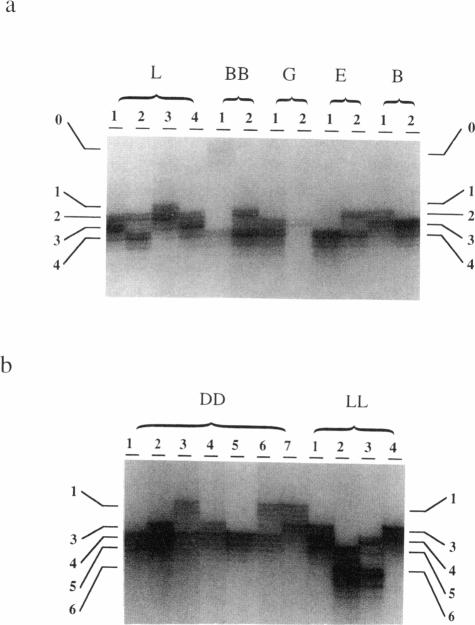
The origins of the beta cardiac myosin heavy-chain (MHC) gene missense mutations that cause familial hypertrophic cardiomyopathy (FHC) in 14 families have been evaluated. Of eight different mutations, four were present in single families, while four occurred in two or more families. To investigate the origins of the four shared mutations, we defined the beta cardiac MHC haplotypes of each of the mutation-bearing chromosomes by determining the alleles present at three intragenic polymorphic loci. Two of the mutations (Arg453Cys and Val606Met) have arisen independently in each of three families, being found on different chromosomal backgrounds. A third mutation (Gly584Arg) is associated with identical haplotypes in two families with Portuguese ancestors, suggesting a founder effect. Haplotype analysis was uninformative for the fourth mutation (Arg403Gln). Thus, FHC-causing mutations have arisen independently in at least 12 of the 14 families studied, suggesting that the majority have arisen relatively recently as new mutations. This finding predicts the prevalence of disease-causing beta cardiac MHC mutations to be comparable in all population groups.
对14个家族中导致家族性肥厚型心肌病(FHC)的β-心脏肌球蛋白重链(MHC)基因错义突变的起源进行了评估。在8种不同的突变中,4种出现在单个家族中,而4种发生在两个或更多家族中。为了研究这4种共享突变的起源,我们通过确定三个基因内多态性位点上存在的等位基因,定义了每个携带突变的染色体的β-心脏MHC单倍型。其中两个突变(Arg453Cys和Val606Met)在三个家族中的每一个家族中都是独立出现的,位于不同的染色体背景上。第三个突变(Gly584Arg)在两个有葡萄牙祖先的家族中与相同的单倍型相关,提示存在奠基者效应。单倍型分析对第四个突变(Arg403Gln)没有提供信息。因此,在研究的14个家族中,至少有12个家族中导致FHC的突变是独立出现的,这表明大多数突变是相对较新出现的新突变。这一发现预示着致病的β-心脏MHC突变在所有人群中的患病率相当。