Ruiz de Mena I, Mahillo E, Arribas J, Castaño J G
Departamento de Bioquímica, Facultad de Medicina de la UAM, Madrid, Spain.
Biochem J. 1993 Nov 15;296 ( Pt 1)(Pt 1):93-7. doi: 10.1042/bj2960093.
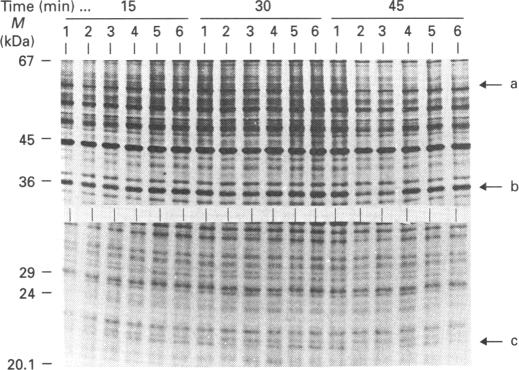
The effect of phospholipids on the trypsin-like, chymotrypsin-like and peptidylglutamyl-peptide-hydrolysing activities of the so-called latent form of the rat liver multicatalytic proteinase was studied, assaying them with the following substrates: N-Cbz-ARR-4MNA (N-Cbz, N-benzyloxycarbonyl; 4MNA, 4-methoxy-beta-naphthylamide), N-Suc-LLVY-MCA (N-Suc, N-succinyl; MCA, methylcoumarin) and N-Cbz-LLE-beta-NA (beta-NA, beta-naphthylamide) respectively (amino acids are shown as their one-letter symbol). For the most part neither lysophospholipids nor phospholipids at 20 micrograms/ml have any effect on the activity of the enzyme (assayed at 50 microM peptide), except for phosphatidylserine, which activates 2-fold the hydrolysis of N-Suc-LLVY-MCA, and phosphatidylinositol, which inhibits by 20% the hydrolysis of N-Cbz-LLE-beta-NA. By contrast, cardiolipin (diphosphatidylglycerol) is a strong activator of the hydrolysis of N-Suc-LLVY-MCA (60-fold) and N-Cbz-LLE-beta-NA (30-fold), with half-maximal activation at concentrations of 0.15 micrograms/ml and 1.5 micrograms/ml respectively. The activation of N-Suc-LLVY-MCA hydrolysis is due to an increase of the affinity of the enzyme for the peptide and to an increase in the Vmax. (30-fold). The activation of N-Cbz-LLE-beta-NA hydrolysis is explained by suppressing the co-operativity for this substrate, producing hyperbolic kinetics with a Km of 60 microM and a 15-fold increase in the Vmax. of the enzyme. This activation by cardiolipin was completely suppressed by micromolar concentrations of fluophenazine, a drug known to inhibit other phospholipid-regulated process. Cardiolipin activation and the known activation by SDS are additive, either at suboptimal or optimal concentrations of both activators. Cardiolipin also activates the in vitro degradation of some proteins from metabolically labelled total cellular extracts by the latent multicatalytic proteinase. These results clearly show that cardiolipin is a natural positive modulator of the peptidase and proteolytic activities of the multicatalytic proteinase, probably acting through a binding site different from that of SDS.
研究了磷脂对大鼠肝脏多催化蛋白酶所谓潜在形式的类胰蛋白酶、类胰凝乳蛋白酶和肽基谷氨酰肽水解活性的影响,分别用以下底物进行测定:N-Cbz-ARR-4MNA(N-Cbz,N-苄氧羰基;4MNA,4-甲氧基-β-萘酰胺)、N-Suc-LLVY-MCA(N-Suc,N-琥珀酰;MCA,甲基香豆素)和N-Cbz-LLE-β-NA(β-NA,β-萘酰胺)(氨基酸以其单字母符号表示)。在很大程度上,无论是溶血磷脂还是20微克/毫升的磷脂对该酶活性(在50微摩尔肽浓度下测定)均无影响,但磷脂酰丝氨酸可使N-Suc-LLVY-MCA的水解活性提高2倍,磷脂酰肌醇可使N-Cbz-LLE-β-NA的水解活性降低20%。相比之下,心磷脂(二磷脂酰甘油)是N-Suc-LLVY-MCA(60倍)和N-Cbz-LLE-β-NA(30倍)水解的强激活剂,半最大激活浓度分别为0.15微克/毫升和1.5微克/毫升。N-Suc-LLVY-MCA水解的激活是由于酶对肽的亲和力增加以及Vmax增加(30倍)。N-Cbz-LLE-β-NA水解的激活是通过抑制该底物协同作用来解释的,产生双曲线动力学,Km为60微摩尔,酶的Vmax增加15倍。微摩尔浓度的氟奋乃静可完全抑制心磷脂的这种激活作用,氟奋乃静是一种已知可抑制其他磷脂调节过程的药物。在心磷脂激活和SDS已知激活作用方面,无论是在两种激活剂的次优浓度还是最佳浓度下,二者具有加和性。心磷脂还可激活潜在多催化蛋白酶对代谢标记的全细胞提取物中某些蛋白质的体外降解。这些结果清楚地表明,心磷脂是多催化蛋白酶肽酶和蛋白水解活性的天然正调节剂,可能通过与SDS不同的结合位点发挥作用。