Department of Pharmaceutical Chemistry, University of California, San Francisco, San Francisco, California 94158.
Department of Pharmaceutical Chemistry, University of California, San Francisco, San Francisco, California 94158.
Transl Res. 2018 Aug;198:48-57. doi: 10.1016/j.trsl.2018.05.002. Epub 2018 Jun 19.
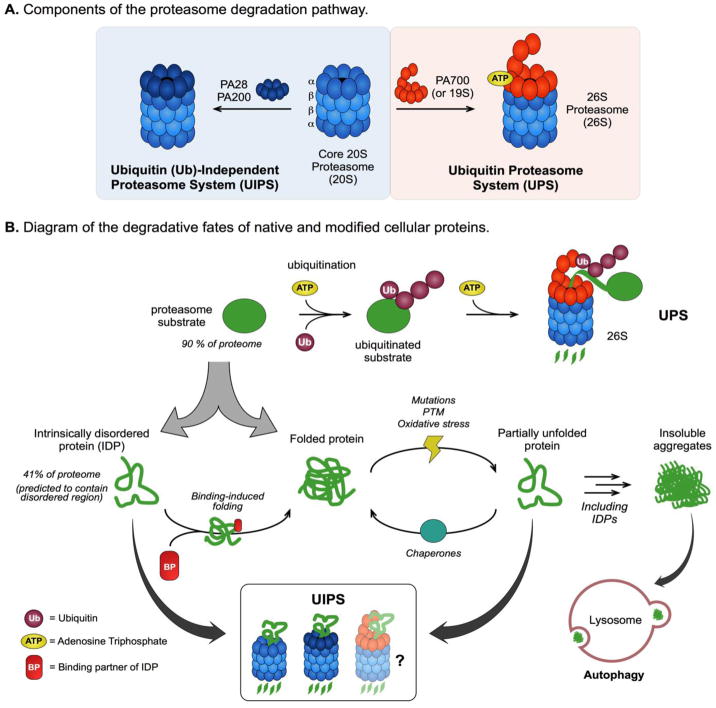
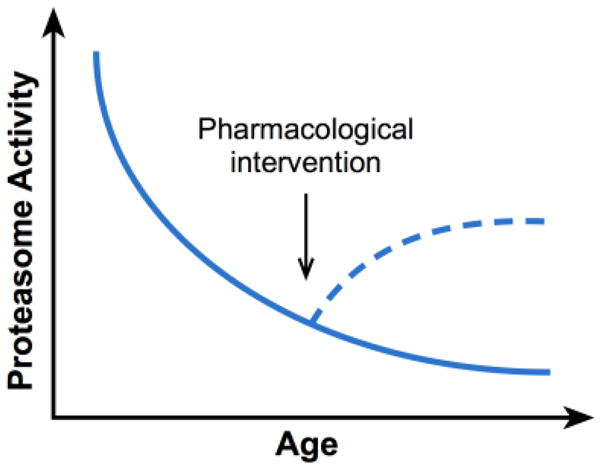
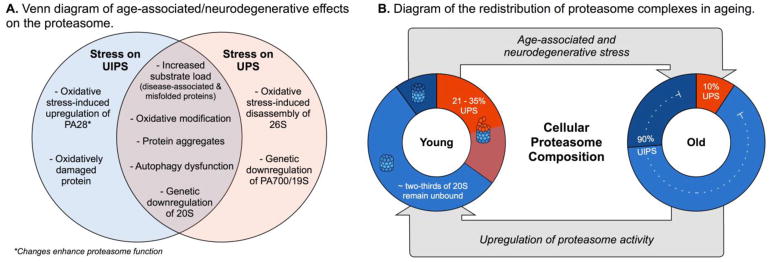
Neurodegenerative diseases are a class of age-associated proteopathies characterized by the accumulation of misfolded and/or aggregation-prone proteins. This imbalance has been attributed, in part, to an age-dependent decay in the capacity of protein turnover. Most proteins are degraded by the ubiquitin-proteasome system (UPS), which is composed of ubiquitin ligases and regulatory particles, such as the 19S, that deliver cargo to the proteolytically active 20S proteasome (20S) core. However, a subset of clients, especially intrinsically disordered proteins (IDPs), are also removed by the action of the ubiquitin-independent proteasome system (UIPS). What are the specific contributions of the UPS and UIPS in the context of neurodegeneration? Here, we explore how age-associated changes in the relative contribution of the UPS and UIPS, combined with the IDP-like structure of many neurodegenerative disease-associated proteins, might contribute. Strikingly, the 20S has been shown to predominate in older neurons and to preferentially act on relevant substrates, such as synuclein and tau. Moreover, pharmacological activation of the 20S has been shown to accelerate removal of aggregation-prone proteins in some models. Together, these recent studies are turning attention to the 20S and the UIPS as potential therapeutic targets in neurodegeneration.
神经退行性疾病是一类与年龄相关的蛋白病,其特征是错误折叠和/或易于聚集的蛋白质积累。这种失衡部分归因于蛋白质周转能力随年龄的依赖性下降。大多数蛋白质被泛素蛋白酶体系统 (UPS) 降解,该系统由泛素连接酶和调节颗粒组成,例如 19S,它将货物递送到具有蛋白水解活性的 20S 蛋白酶体 (20S) 核心。然而,一部分客户,特别是固有无序蛋白 (IDP),也可以通过非泛素依赖的蛋白酶体系统 (UIPS) 的作用被去除。在神经退行性变的背景下,UPS 和 UIPS 的具体贡献是什么?在这里,我们探讨了 UPS 和 UIPS 的相对贡献随年龄的变化,以及许多神经退行性疾病相关蛋白的 IDP 样结构,可能会产生怎样的影响。引人注目的是,20S 在老年神经元中占主导地位,并且优先作用于相关底物,如突触核蛋白和 tau。此外,已有研究表明,20S 的药理学激活可以加速一些模型中易于聚集的蛋白质的清除。这些最近的研究将注意力集中在 20S 和 UIPS 作为神经退行性变的潜在治疗靶点上。