Rice S A, Lam V
Department of Biochemistry, University of Alberta, Edmonton, Canada.
J Virol. 1994 Feb;68(2):823-33. doi: 10.1128/JVI.68.2.823-833.1994.
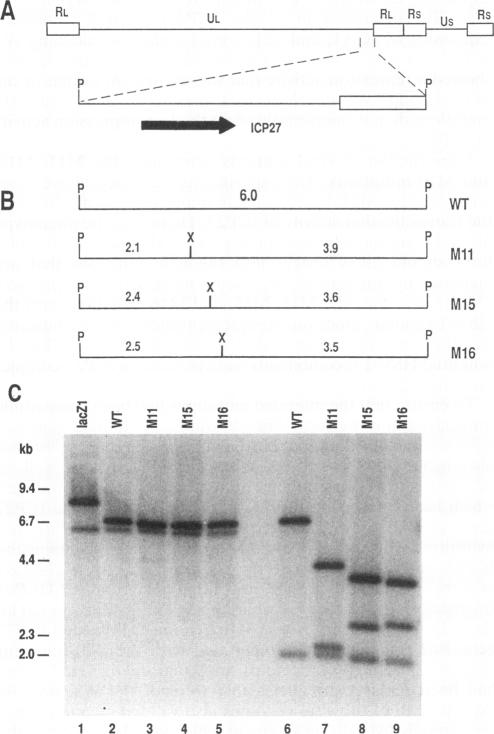
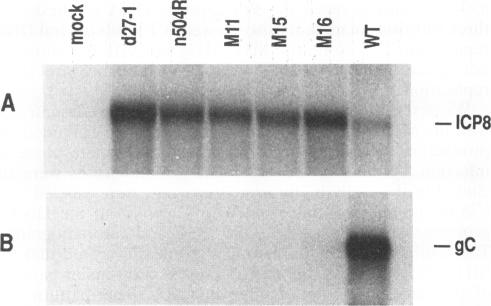
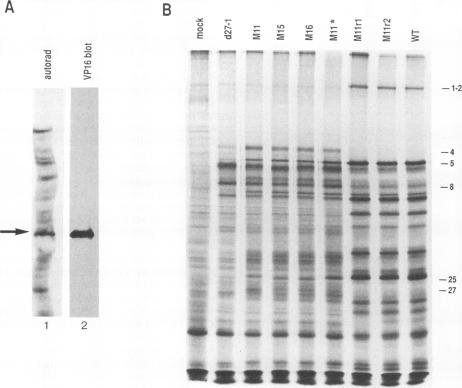
ICP27 is an essential herpes simplex virus type 1 (HSV-1) alpha protein that is required for the transition from the beta to the gamma phase of infection. To identify functional regions of ICP27, we constructed 16 plasmids that contain nucleotide substitution mutations in the ICP27 gene. The mutations created XhoI restriction sites, altered one or two codons, and were spaced at semiregular intervals throughout the coding region. Three mutations completely inactivated an essential function of ICP27, as demonstrated by the inability of the transfected plasmids to complement the growth of an HSV-1 ICP27 deletion mutant. These mutations, M11, M15, and M16, mapped in the carboxyl-terminal one-third of ICP27 at residues 340 and 341, 465 and 466, and 488, respectively. In cotransfection assays, all three defective-plasmid mutants retained the transrepression function of ICP27 but were defective at transactivation. To define the lytic functions that are mediated by the transactivation activity of ICP27, we engineered HSV-1 recombinants containing the M11, M15, or M16 mutation. All three viral mutants failed to grow in Vero cells and possessed similar phenotypes. The viral mutants replicated their DNA similarly to the wild-type virus but showed several defects in viral gene expression. These were a failure to down-regulate alpha and beta genes at late times after infection and an inability to induce certain gamma-2 genes. Our results demonstrate that the transactivation function of ICP27 (as it is defined in cotransfection assays) mediates an essential gene regulation function during the HSV-1 infection. This activity is not required for ICP27-dependent enhancement of viral DNA replication. Our work supports and extends previous studies which suggest that ICP27 carries out two distinct regulatory activities during the HSV-1 infection.
ICP27是1型单纯疱疹病毒(HSV-1)的一种必需α蛋白,是感染从β期过渡到γ期所必需的。为了确定ICP27的功能区域,我们构建了16个质粒,这些质粒在ICP27基因中含有核苷酸取代突变。这些突变产生了XhoI限制性酶切位点,改变了一两个密码子,并在整个编码区域以半规则间隔分布。三个突变完全失活了ICP27的一项基本功能,转染的质粒无法补充HSV-1 ICP27缺失突变体的生长就证明了这一点。这些突变,即M11、M15和M16,分别位于ICP27羧基末端三分之一处的第340和341位、465和466位以及488位残基处。在共转染试验中,所有三个缺陷质粒突变体都保留了ICP27的反式抑制功能,但在反式激活方面存在缺陷。为了确定由ICP27的反式激活活性介导的裂解功能,我们构建了含有M11、M15或M16突变的HSV-1重组体。所有三个病毒突变体都无法在Vero细胞中生长,并且具有相似的表型。这些病毒突变体与野生型病毒类似地复制其DNA,但在病毒基因表达方面表现出几个缺陷。这些缺陷包括在感染后期未能下调α和β基因,以及无法诱导某些γ-2基因。我们的结果表明,ICP27的反式激活功能(如在共转染试验中所定义的)在HSV-1感染期间介导了一项基本的基因调控功能。这种活性对于依赖ICP27的病毒DNA复制增强不是必需的。我们的工作支持并扩展了先前的研究,这些研究表明ICP27在HSV-1感染期间执行两种不同的调控活动。