Rice S A, Lam V, Knipe D M
Department of Biochemistry, University of Alberta, Edmonton, Canada.
J Virol. 1993 Apr;67(4):1778-87. doi: 10.1128/JVI.67.4.1778-1787.1993.
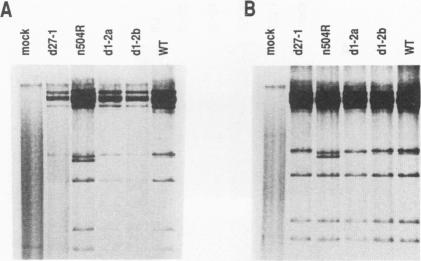
The herpes simplex virus type 1 (HSV-1) alpha protein ICP27 regulates the transition between the delayed-early and late phases of the viral infection. Previous genetic analyses have suggested that the important functional domains of ICP27 map to its carboxyl-terminal half. One striking feature of the primary sequence of ICP27, however, is an extremely acidic region near its amino terminus. To determine whether this region is required for ICP27 function, we deleted the sequences in the ICP27 gene which encode it (codons 12 through 63). In transient expression assays, the deletion mutant was unable to efficiently repress the expression of a cotransfected reporter gene or to efficiently complement the growth of d27-1, an HSV-1 ICP27 null mutant. These results suggested that the acidic region of ICP27 is involved in a regulatory function required for lytic growth. To test this possibility further, we introduced the mutant allele into the HSV-1 genome by marker transfer. Two independently derived isolates of the mutant virus, designated d1-2a and d1-2b, were recovered and analyzed. Both isolates were defective for growth in Vero cells, exhibiting a 100-fold reduction in virus yield compared with the wild-type infection. Vero cells infected with the d1-2 isolates showed a three- to eightfold reduction in viral DNA replication, a moderate reduction in the expression of viral gamma genes, and a delay in the repression of beta genes. The phenotype of the d1-2 isolates differs substantially from the phenotypes of previously isolated ICP27 mutants, which show much more severe defects in viral gene expression. Our results demonstrate that the amino-terminal half of ICP27 participates in its regulatory activities in both infected and transfected cells.
单纯疱疹病毒1型(HSV-1)的α蛋白ICP27可调节病毒感染过程中延迟早期和晚期之间的转换。先前的遗传学分析表明,ICP27的重要功能域位于其羧基末端的一半区域。然而,ICP27一级序列的一个显著特征是其氨基末端附近有一个极端酸性区域。为了确定该区域是否是ICP27功能所必需的,我们删除了ICP27基因中编码该区域的序列(第12至63密码子)。在瞬时表达试验中,缺失突变体无法有效抑制共转染报告基因的表达,也无法有效互补HSV-1 ICP27缺失突变体d27-1的生长。这些结果表明,ICP27的酸性区域参与了裂解生长所需的调节功能。为了进一步验证这种可能性,我们通过标记转移将突变等位基因导入HSV-1基因组。回收并分析了两个独立获得的突变病毒分离株,分别命名为d1-2a和d1-2b。这两个分离株在Vero细胞中生长均有缺陷,与野生型感染相比,病毒产量降低了100倍。感染d1-2分离株的Vero细胞的病毒DNA复制减少了三到八倍,病毒γ基因的表达适度降低,β基因的抑制延迟。d1-2分离株的表型与先前分离的ICP27突变体的表型有很大不同,后者在病毒基因表达方面表现出更严重的缺陷。我们的结果表明,ICP27的氨基末端一半区域在感染细胞和转染细胞中均参与其调节活性。