Kagawa T F, Howell M L, Tseng K, Ho P S
Department of Biochemistry and Biophysics, Oregon State University, Corvallis 97331.
Nucleic Acids Res. 1993 Dec 25;21(25):5978-86. doi: 10.1093/nar/21.25.5978.
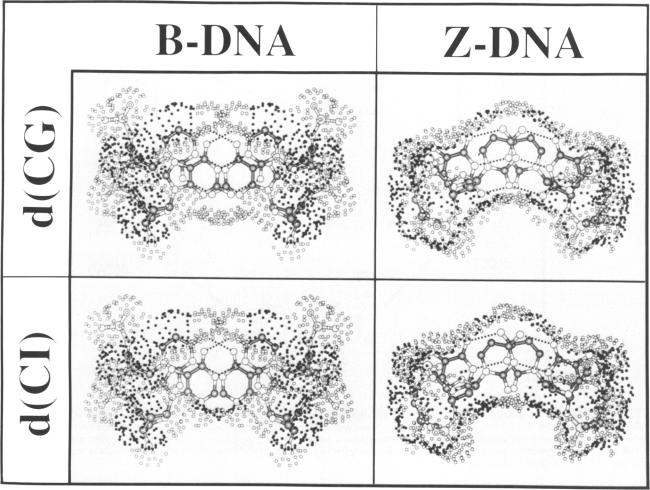
We present a study of how substituent groups of naturally occurring and modified nucleotide bases affect the degree of hydration of right-handed B-DNA and left-handed Z-DNA. A comparison of poly(dG-dC) and poly(dG-dm5C) titrations with the lipotropic salts of the Hofmeister series infers that the methyl stabilization of cytosines as Z-DNA is primarily a hydrophobic effect. The hydration free energies of various alternating pyrimidine-purine sequences in the two DNA conformations were calculated as solvent free energies from solvent accessible surfaces. Our analysis focused on the N2 amino group of purine bases that sits in the minor groove of the double helix. Removing this amino group from guanine to form inosine (I) destabilizes Z-DNA, while adding this group to adenines to form 2-aminoadenine (A') stabilizes Z-DNA. These predictions were tested by comparing the salt concentrations required to crystallize hexanucleotide sequences that incorporate d(CG), d(CI), d(TA) and d(TA') base pairs as Z-DNA. Combining the current results with our previous analysis of major groove substituents, we derived a thermodynamic cycle that relates the systematic addition, deletion, or substitution of each base substituent to the B- to Z-DNA transition free energy.
我们展示了一项关于天然存在的和修饰的核苷酸碱基的取代基团如何影响右手B-DNA和左手Z-DNA水合程度的研究。将聚(dG-dC)和聚(dG-dm5C)与霍夫迈斯特系列的亲脂性盐进行滴定比较,推断出胞嘧啶作为Z-DNA的甲基稳定作用主要是一种疏水效应。根据溶剂可及表面计算出两种DNA构象中各种交替嘧啶-嘌呤序列的水合自由能,作为溶剂自由能。我们的分析集中在位于双螺旋小沟中的嘌呤碱基的N2氨基上。从鸟嘌呤上去除这个氨基形成次黄嘌呤(I)会使Z-DNA不稳定,而将这个基团添加到腺嘌呤上形成2-氨基腺嘌呤(A')会使Z-DNA稳定。通过比较使包含d(CG)、d(CI)、d(TA)和d(TA')碱基对作为Z-DNA的六核苷酸序列结晶所需的盐浓度,对这些预测进行了测试。将当前结果与我们之前对大沟取代基的分析相结合,我们得出了一个热力学循环,该循环将每个碱基取代基的系统添加、删除或替换与B-DNA到Z-DNA的转变自由能联系起来。