Chow M, Yao A, Rubin H
Department of Molecular and Cell Biology, University of California, Berkeley 94720.
Proc Natl Acad Sci U S A. 1994 Jan 18;91(2):599-603. doi: 10.1073/pnas.91.2.599.
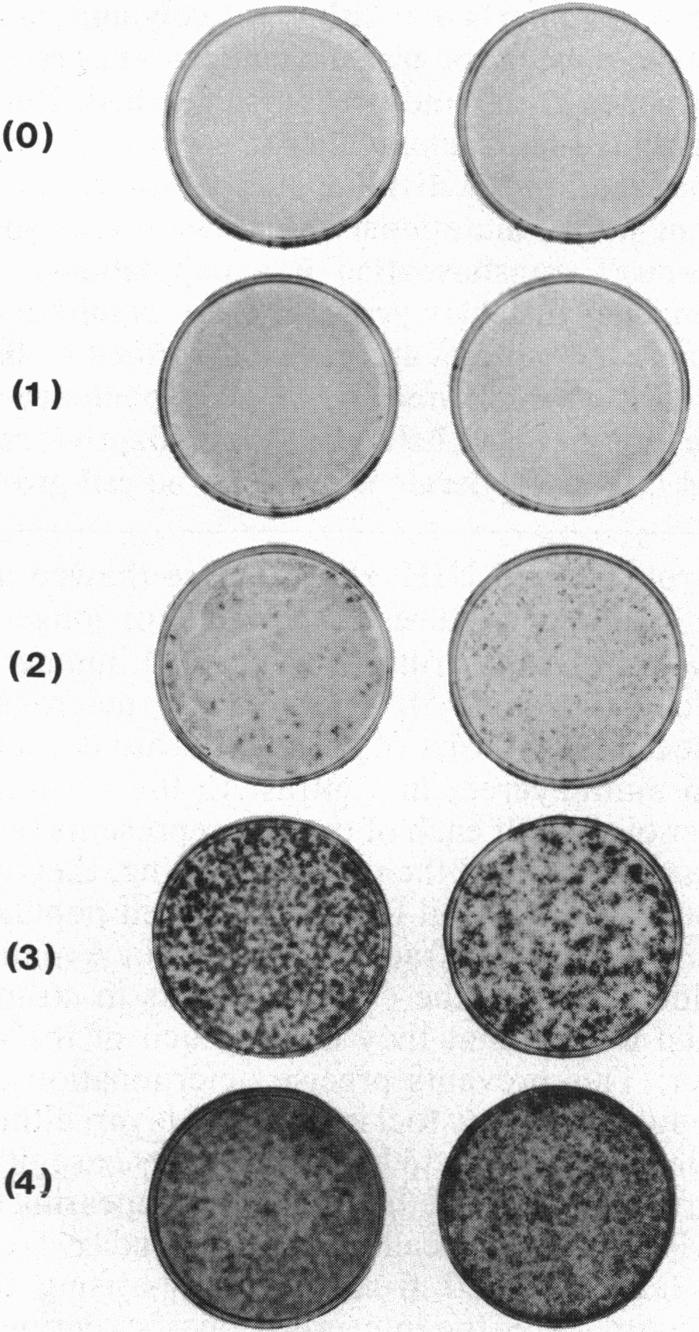
Early passages of NIH 3T3 cells yield about 10 transformed foci for every 10(5) cells seeded after the cells multiply to confluence in a standardized 2-week assay. The question arose whether more cells would give rise to foci if given more time for their development. This question could not be answered simply by extending the incubation period, since the original foci spread to cover much of the area of the culture dish. Transformed cells can also detach into the medium from the original foci to initiate new foci by reattaching at a distance. These problems were averted by growing cells in multiwell plates which in effect simulated partitioned culture dishes. All the wells in a given plate were assayed for focus formation at successive intervals up to 14 weeks. The results indicated the spatial pattern and sequence of transformation on different parts of the "partitioned" dish. The number of multiwells containing focus-forming cells increased steadily with time, indicating that all parts of a dish eventually undergo transformation. Also, most of the transformations were recorded long after confluence in the multiwells was reached. Hence such a transformation is much more likely to occur in the nondividing state rather than in the dividing state of the cells and is thus inconsistent with a mutational basis. The results suggest that "spontaneous" transformation is a population-wide, epigenetic phenomenon. This agrees with the results from clonal analysis and other studies and is well described by the concept of progressive state selection, in which "spontaneous" transformation represents a heterogeneous, adaptive response of competent cells to moderate constraints on cell growth.
在一项标准化的为期两周的实验中,将NIH 3T3细胞培养至汇合后,每接种10⁵个细胞,早期传代培养可产生约10个转化灶。于是就出现了一个问题:如果给更多时间让细胞发育,更多的细胞是否会产生转化灶。这个问题不能简单地通过延长孵育期来回答,因为最初的转化灶会扩散并覆盖培养皿的大部分区域。转化细胞也会从原始转化灶脱离进入培养基,通过在远处重新附着形成新的转化灶。通过在多孔板中培养细胞避免了这些问题,多孔板实际上模拟了分隔的培养皿。对给定平板中的所有孔在长达14周的连续间隔内进行转化灶形成检测。结果显示了“分隔”培养皿不同部位转化的空间模式和顺序。含有形成转化灶细胞的多孔板数量随时间稳步增加,表明培养皿的所有部位最终都会发生转化。此外,大多数转化是在多孔板达到汇合后很长时间才记录到的。因此,这种转化更有可能发生在细胞的非分裂状态而非分裂状态,所以与突变基础不一致。结果表明“自发”转化是一种群体水平的表观遗传现象。这与克隆分析和其他研究的结果一致,并且用渐进状态选择的概念可以很好地描述这一现象,即“自发”转化代表了有能力的细胞对细胞生长适度限制的一种异质性、适应性反应。