Verhofstad A A
Department of Pathology, University of Nijmegen, The Netherlands.
J Anat. 1993 Oct;183 ( Pt 2)(Pt 2):315-26.
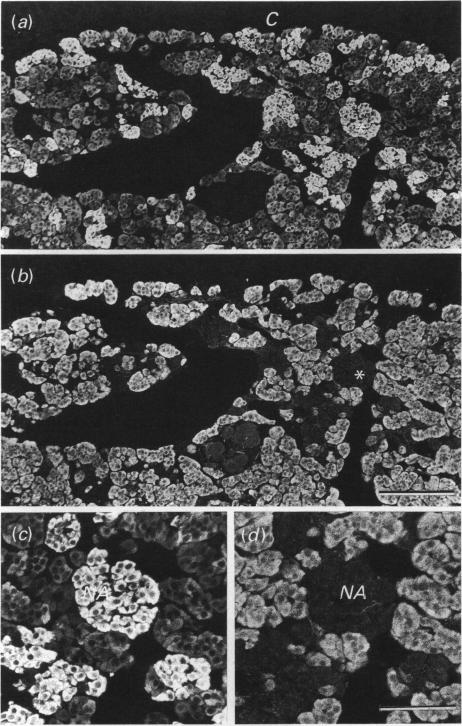
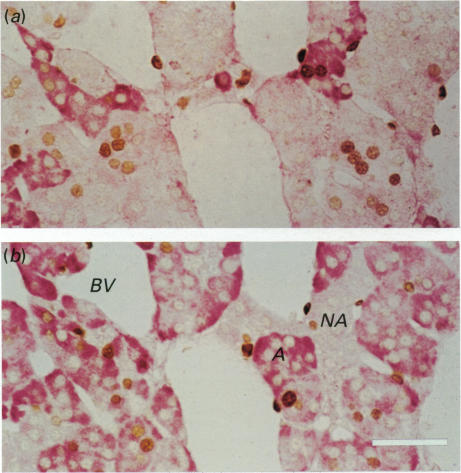
The adrenal medulla of mammals has a heterogeneous population of cells. In adults most are epithelial cells containing a particular type of cytoplasmic granule. Based on a variety of cytochemical and ultrastructural studies it is now accepted that 2 different adrenal medullary chromaffin cell types can be distinguished, i.e. noradrenaline (NA) and adrenaline (A) synthesising and storing cells. Other cell types present in the adrenal medulla include neuronal elements comprising either cell bodies or nerve fibres entering from outside the gland (extrinsic innervation). It is assumed that adrenal medullary cells have a limited life span, i.e. they are replaced after a certain period. Data on this replacement process are scarce. Recently, we initiated an investigation into this question using cytochemical procedures that enable the detection of DNA duplication to measure mitotic activity in individual cells. Female Sprague-Dawley rats aged 22-36 wk received a single i.p. injection of BrdU or BrdU was administered continuously via an implanted mini-osmotic pump. Cell nuclei that had incorporated BrdU were demonstrated using an indirect immunoperoxidase staining technique. At 1 h after a single injection, 0.46 +/- 0.07% of the adrenal medullary (chromaffin) cells were labelled. This increased to 0.77 +/- 0.08% after 12 h with no further increase during the next 7-8 d. With continuous infusion of BrdU the fraction of labelled cells increased gradually to about 40% after 73 d (the longest period studied). These results show that in adult rats adrenal medullary cells are able to divide, although at a slow rate (renewal rate of about 1%/day).
哺乳动物的肾上腺髓质有多种不同类型的细胞。在成年动物中,大多数是含有特定类型细胞质颗粒的上皮细胞。基于各种细胞化学和超微结构研究,现在人们认为可以区分出两种不同类型的肾上腺髓质嗜铬细胞,即合成和储存去甲肾上腺素(NA)的细胞以及合成和储存肾上腺素(A)的细胞。肾上腺髓质中存在的其他细胞类型包括神经元成分,它们由细胞体或从腺体外部进入的神经纤维组成(外部神经支配)。据推测,肾上腺髓质细胞的寿命有限,即它们在一定时期后会被替换。关于这个替换过程的数据很少。最近,我们使用能够检测DNA复制以测量单个细胞有丝分裂活性的细胞化学方法,对这个问题展开了研究。22 - 36周龄的雌性Sprague-Dawley大鼠经腹腔单次注射溴脱氧尿苷(BrdU),或者通过植入的微型渗透泵持续给予BrdU。使用间接免疫过氧化物酶染色技术显示已掺入BrdU的细胞核。单次注射后1小时,0.46±0.07%的肾上腺髓质(嗜铬)细胞被标记。12小时后这一比例增加到0.77±0.08%,在接下来的7 - 8天内没有进一步增加。持续输注BrdU时,标记细胞的比例在73天(研究的最长时间)后逐渐增加到约40%。这些结果表明,成年大鼠的肾上腺髓质细胞能够分裂,尽管分裂速度较慢(更新率约为1%/天)。