Castaing B, Geiger A, Seliger H, Nehls P, Laval J, Zelwer C, Boiteux S
Laboratoire de Biologie Structurale du CNRS, Gif sur Yvette, France.
Nucleic Acids Res. 1993 Jun 25;21(12):2899-905. doi: 10.1093/nar/21.12.2899.
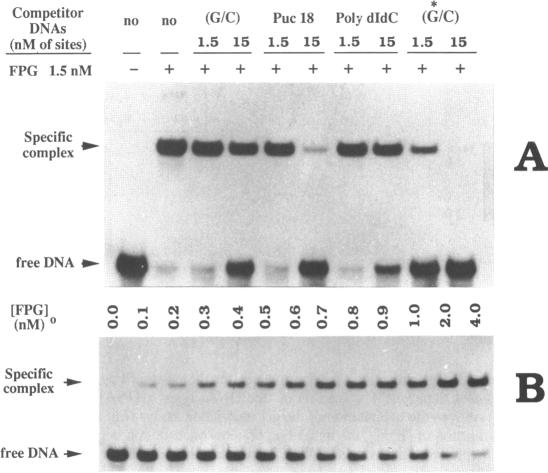
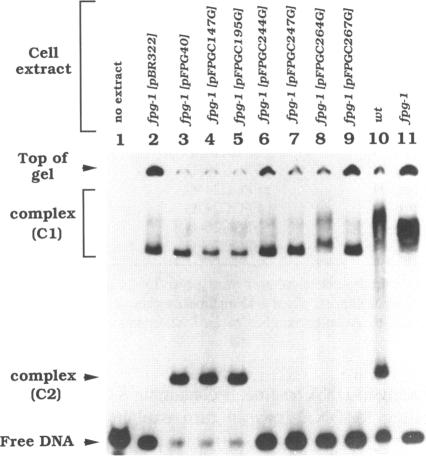
A 34-mer oligonucleotide containing a single 7,8-dihydro-8-oxoguanine (8-OxoG) residue was used to study the enzymatic and DNA binding properties of the Fpg protein from E. coli. The highest rates of incision of the 8-OxoG containing strand by the Fpg protein were observed for duplexes where 8-OxoG was opposite C (*G/C) or T (*G/T). In contrast, the rates of incision of duplexes containing 8-OxoG opposite G (*G/G) and A (*G/A) were 5-fold and 200-fold slower. Gel retardation studies showed that the Fpg protein had a strong affinity for duplexes where the 8-OxoG was opposite pyrimidines and less affinity for duplexes where the 8-OxoG was opposite purines. KDapp values were 0.6 nM (*G/C), 1.0 nM (*G/T), 6.0 nM (*G/G) and 16.0 nM (*G/A). The Fpg protein also binds to unmodified (G/C) duplex and a KDapp of 90 nM was measured. The cleavage and binding of the (*G/C) duplex were also studied using bacterial crude lysates. Wild type E. coli crude extract incised the 8-OxoG containing strand and formed a specific retardation complex with the (*G/C) duplex. These two reactions were mediated by the Fpg protein, since they were not observed with a crude extract from a bacterial strain whose fpg gene was inactivated. Furthermore, we have studied the properties of 6 mutant Fpg proteins with Cys-->Gly mutations. The results showed that the 2 Fpg proteins with Cys-->Gly mutations outside the zinc finger sequence cleaved the 8-OxoG containing strand, formed complexes with the (*G/C) duplex and suppressed the mutator phenotype of the fpg-1 mutant. In contrast, the 4 Fpg proteins with Cys-->Gly mutations within the zinc finger motif neither cleave nor bind the (*G/C) duplex, nor do these proteins suppress the fpg-1 mutator phenotype.
一条含有单个7,8 - 二氢 - 8 - 氧代鸟嘌呤(8 - OxoG)残基的34聚体寡核苷酸被用于研究来自大肠杆菌的Fpg蛋白的酶促和DNA结合特性。对于8 - OxoG与C(*G/C)或T(*G/T)相对的双链体,观察到Fpg蛋白切割含8 - OxoG链的速率最高。相比之下,8 - OxoG与G(*G/G)和A(*G/A)相对的双链体的切割速率分别慢5倍和200倍。凝胶阻滞研究表明,Fpg蛋白对8 - OxoG与嘧啶相对的双链体具有很强的亲和力,而对8 - OxoG与嘌呤相对的双链体亲和力较小。解离常数(KDapp)值分别为0.6 nM(*G/C)、1.0 nM(*G/T)、6.0 nM(*G/G)和16.0 nM(*G/A)。Fpg蛋白也与未修饰的(G/C)双链体结合,测得的KDapp为90 nM。还使用细菌粗裂解物研究了(*G/C)双链体的切割和结合。野生型大肠杆菌粗提取物切割含8 - OxoG的链,并与(*G/C)双链体形成特异性阻滞复合物。这两个反应由Fpg蛋白介导,因为在fpg基因失活的细菌菌株的粗提取物中未观察到这些反应。此外,我们研究了6种具有半胱氨酸到甘氨酸突变的Fpg突变蛋白的特性。结果表明,在锌指序列外具有半胱氨酸到甘氨酸突变的2种Fpg蛋白切割含8 - OxoG的链,与(*G/C)双链体形成复合物,并抑制fpg - 1突变体的诱变表型。相比之下,在锌指基序内具有半胱氨酸到甘氨酸突变的4种Fpg蛋白既不切割也不结合(*G/C)双链体,这些蛋白也不抑制fpg - 1诱变表型。