Flemington E K, Speck S H, Kaelin W G
Division of Tumor Virology, Dana-Farber Cancer Institute, Harvard Medical School, Boston, MA 02115.
Proc Natl Acad Sci U S A. 1993 Aug 1;90(15):6914-8. doi: 10.1073/pnas.90.15.6914.
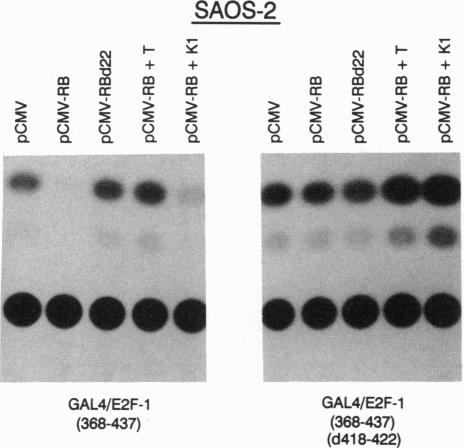
Previous studies have shown that the carboxyl-terminal region of E2F-1 (residues 368-437) can support transcriptional activation when linked to the DNA-binding domain of the yeast transcription factor GAL4. This region also contains an 18-residue retinoblastoma (RB)-binding sequence, raising the possibility that RB binding might inhibit the ability of E2F-1 to form protein-protein contacts required for activation. Here we report a further analysis of the E2F-1 activation domain. In addition, we show that overexpression of RB, but not the RB mutant, RBd22, can inhibit GAL4/E2F-1 activity in vivo. Moreover, expression of the simian virus 40 large tumor antigen (T antigen), but not the RB-binding defective T antigen point mutant, K1, can overcome this repression. Three different GAL4/E2F-1 mutants that activate transcription, but fail to bind to RB, are not significantly affected by overexpression of RB. These findings support a model wherein RB suppresses E2F-1-mediated transcriptional activation through direct physical association.
先前的研究表明,E2F-1的羧基末端区域(第368 - 437位氨基酸残基)与酵母转录因子GAL4的DNA结合结构域相连时,能够支持转录激活。该区域还包含一个18个氨基酸残基的视网膜母细胞瘤(RB)结合序列,这增加了RB结合可能抑制E2F-1形成激活所需的蛋白质 - 蛋白质相互作用能力的可能性。在此,我们报告了对E2F-1激活结构域的进一步分析。此外,我们表明,RB的过表达而非RB突变体RBd22能够在体内抑制GAL4/E2F-1活性。而且,猿猴病毒40大T抗原(T抗原)的表达而非与RB结合缺陷的T抗原点突变体K1能够克服这种抑制作用。三种激活转录但不与RB结合的不同GAL4/E2F-1突变体不受RB过表达的显著影响。这些发现支持了一种模型,即RB通过直接的物理相互作用抑制E2F-1介导的转录激活。