Guilvout I, Mercereau-Puijalon O, Bonnefoy S, Pugsley A P, Carniel E
Unité de Bactériologie Moléculaire et Médicale, Institut Pasteur, Paris, France.
J Bacteriol. 1993 Sep;175(17):5488-504. doi: 10.1128/jb.175.17.5488-5504.1993.
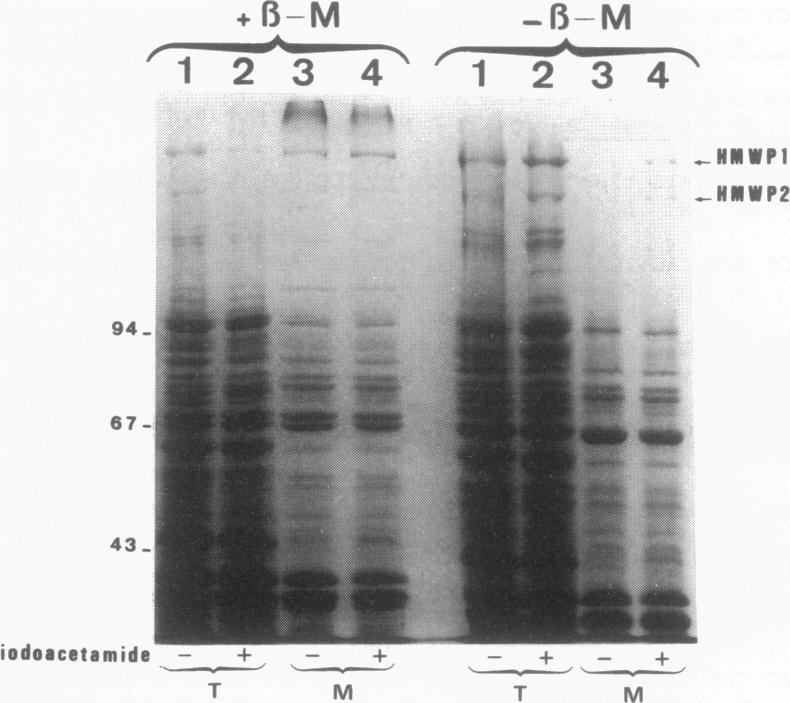
The iron-regulated irp2 gene is specific for the highly pathogenic Yersinia species and encodes high-molecular-weight protein 2 (HMWP2). Despite the established correlation between the presence of HMWP2 and virulence, the role of this protein is still unknown. To gain insight into the function of HMWP2, the entire coding sequence and the promoter of irp2 were sequenced. Two putative -35 and -10 promoter sequences were identified upstream of a large open reading frame, and two potential Fur-binding sites were found overlapping the second -35 box. The large open reading frame is composed of 6,126 nucleotides and may encode a protein of 2,035 amino acids (ca. 228 kDa) with a pI of 5.81. A signal sequence was not present at the N terminus of the protein. Despite the existence of 30 cysteine residues, carboxymethylation prevented the formation of most if not all disulfide bonds that otherwise occurred when the cells were sonicated. The protein was composed of three main domains: a central region of ca. 850 residues, bordered on each side by a repeat of 550 residues. A high degree of identity (44.5%) was found between HMWP2 and the protein AngR of Vibrio anguillarum. The central part of HMWP2 (after removal of a loop of 337 residues) also displayed significant homology with proteins belonging to the superfamily of adenylate-forming enzymes and, like them, possessed a putative ATP-binding motif that is also present in AngR. In addition, HMWP2 shared with the group of antibiotic and enterochelin synthetases a potential amino acid-binding site. Six consensus sequences defining the superfamily and four defining the family of synthetases were derived from the multiple alignment of the 30 sequences of proteins or repeated domains. A phylogenetic tree that was constructed showed that HMWP2 and AngR are in a family composed of Lys2, EntF, and the tyrocidine, gramicidin, and Beta-lactam synthetases. This finding suggests that HMWP2 may participate in the nonribosomal synthesis of small biologically active peptides.
铁调节的irp2基因对高致病性耶尔森菌属具有特异性,编码高分子量蛋白2(HMWP2)。尽管已确定HMWP2的存在与毒力之间存在关联,但该蛋白的作用仍不清楚。为深入了解HMWP2的功能,对irp2的整个编码序列和启动子进行了测序。在一个大的开放阅读框上游鉴定出两个推定的-35和-10启动子序列,并且发现两个潜在的Fur结合位点与第二个-35框重叠。该大的开放阅读框由6126个核苷酸组成,可能编码一个含2035个氨基酸(约228 kDa)、pI为5.81的蛋白质。该蛋白的N端不存在信号序列。尽管存在30个半胱氨酸残基,但羧甲基化阻止了大多数(如果不是全部)二硫键的形成,否则在细胞超声处理时会形成二硫键。该蛋白由三个主要结构域组成:一个约850个残基的中央区域,两侧各有一个550个残基的重复序列。发现HMWP2与鳗弧菌的AngR蛋白之间具有高度同源性(44.5%)。HMWP2的中央部分(去除337个残基的环后)也与属于腺苷酸形成酶超家族的蛋白显示出显著同源性,并且与它们一样,具有一个推定的ATP结合基序,该基序也存在于AngR中。此外,HMWP2与抗生素和肠螯合素合成酶组共享一个潜在的氨基酸结合位点。从30个蛋白质或重复结构域序列的多重比对中得出了定义超家族和定义合成酶家族的六个共有序列。构建的系统发育树表明,HMWP2和AngR属于由Lys2、EntF以及短杆菌酪肽、短杆菌肽和β-内酰胺合成酶组成的家族。这一发现表明HMWP2可能参与小生物活性肽的非核糖体合成。