Schwartz L M, Smith S W, Jones M E, Osborne B A
Department of Biology, University of Massachusetts, Amherst 01003.
Proc Natl Acad Sci U S A. 1993 Feb 1;90(3):980-4. doi: 10.1073/pnas.90.3.980.
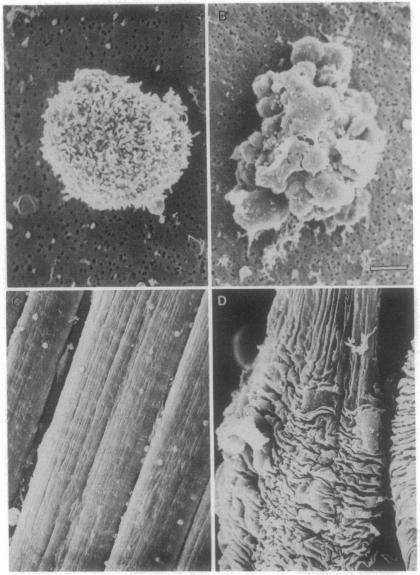
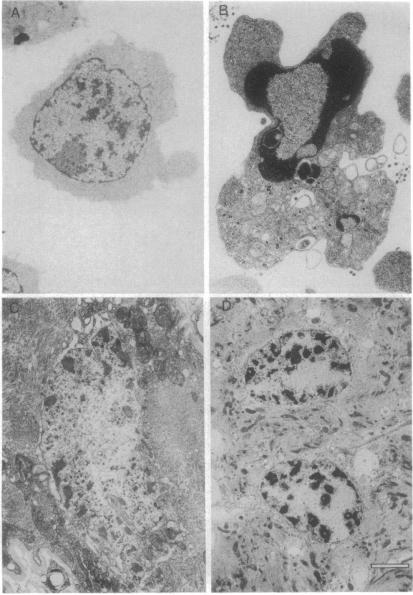
During development, large numbers of cells die by a nonpathological process referred to as programmed cell death. In many tissues, dying cells display similar changes in morphology and chromosomal DNA organization, which has been termed apoptosis. Apoptosis is such a widely documented phenomenon that many authors have assumed all programmed cell deaths occur by this process. Two well-characterized model systems for programmed cell death are (i) the death of T cells during negative selection in the mouse thymus and (ii) the loss of intersegmental muscles of the moth Manduca sexta at the end of metamorphosis. In this report we compare the patterns of cell death displayed by T cells and the intersegmental muscles and find that they differ in terms of cell-surface morphology, nuclear ultrastructure, DNA fragmentation, and polyubiquitin gene expression. Unlike the T cells, which are known to die via apoptosis, we find that the intersegmental muscles display few of the features that characterize apoptosis. These data suggest that more than one cell death mechanism is used during development.
在发育过程中,大量细胞通过一种称为程序性细胞死亡的非病理性过程死亡。在许多组织中,垂死的细胞在形态和染色体DNA组织上表现出相似的变化,这一过程被称为凋亡。凋亡是一个有大量文献记载的现象,以至于许多作者认为所有程序性细胞死亡都是通过这一过程发生的。两个已得到充分研究的程序性细胞死亡模型系统为:(i)小鼠胸腺阴性选择过程中T细胞的死亡;(ii)蛾类烟草天蛾变态末期节间肌的丧失。在本报告中,我们比较了T细胞和节间肌所表现出的细胞死亡模式,发现它们在细胞表面形态、核超微结构、DNA片段化和多聚泛素基因表达方面存在差异。与已知通过凋亡死亡的T细胞不同,我们发现节间肌几乎没有凋亡所特有的特征。这些数据表明,发育过程中使用了不止一种细胞死亡机制。