Gupta A S, Heinen J L, Holaday A S, Burke J J, Allen R D
Department of Biological Sciences and Agronomy, Texas Tech University, Lubbock 79409.
Proc Natl Acad Sci U S A. 1993 Feb 15;90(4):1629-33. doi: 10.1073/pnas.90.4.1629.
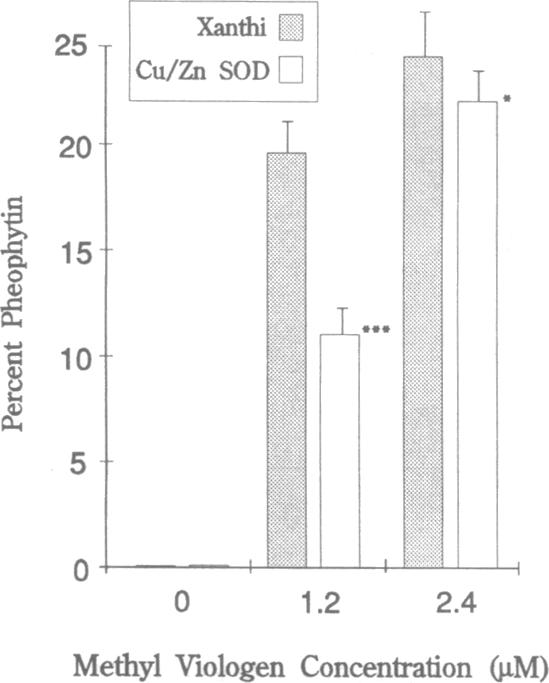
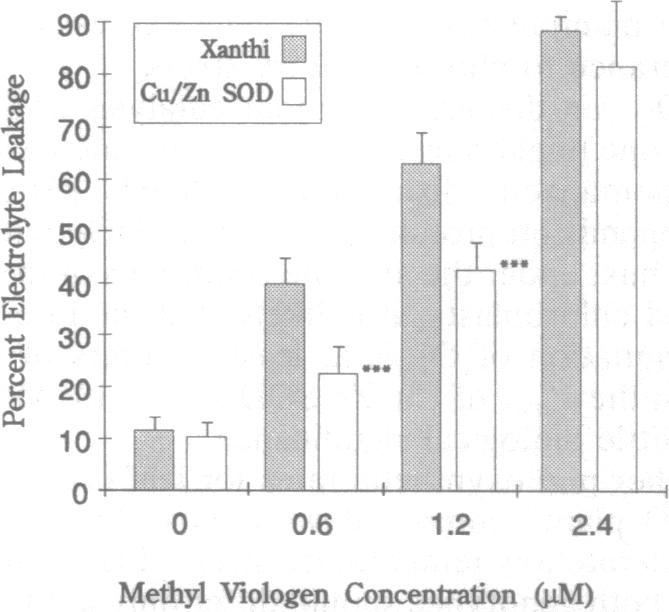
Transgenic tobacco plants that express a chimeric gene that encodes chloroplast-localized Cu/Zn superoxide dismutase (SOD) from pea have been developed. To investigate whether increased expression of chloroplast-targeted SOD could alter the resistance of photosynthesis to environmental stress, these plants were subjected to chilling temperatures and moderate (500 mumol of quanta per m2 per s) or high (1500 mumol of quanta per m2 per s) light intensity. During exposure to moderate stress, transgenic SOD plants retained rates of photosynthesis approximately 20% higher than untransformed tobacco plants, implicating active oxygen species in the reduction of photosynthesis during chilling. Unlike untransformed plants, transgenic SOD plants were capable of maintaining nearly 90% of their photosynthetic capacity (determined by their photosynthetic rates at 25 degrees C) following exposure to chilling at high light intensity for 4 hr. These plants also showed reduced levels of light-mediated cellular damage from the superoxide-generating herbicide methyl viologen. These results demonstrate that SOD is a critical component of the active-oxygen-scavenging system of plant chloroplasts and indicate that modification of SOD expression in transgenic plants can improve plant stress tolerance.
已培育出表达嵌合基因的转基因烟草植株,该嵌合基因编码来自豌豆的叶绿体定位的铜/锌超氧化物歧化酶(SOD)。为了研究叶绿体靶向的SOD表达增加是否会改变光合作用对环境胁迫的抗性,将这些植株置于低温以及中等(每秒每平方米500微摩尔光量子)或高强度(每秒每平方米1500微摩尔光量子)光照强度下。在中等胁迫处理期间,转基因SOD植株的光合作用速率比未转化的烟草植株高约20%,这表明活性氧在低温期间光合作用的降低中起作用。与未转化植株不同,转基因SOD植株在高光强度下低温处理4小时后,能够维持其光合能力(由其在25℃时的光合速率决定)的近90%。这些植株还显示出来自产生超氧化物的除草剂甲基紫精的光介导细胞损伤水平降低。这些结果表明,SOD是植物叶绿体活性氧清除系统的关键组成部分,并表明转基因植物中SOD表达的改变可以提高植物的胁迫耐受性。