Smékal O, Yasin M, Fewson C A, Reid G A, Chapman S K
Department of Chemistry, University of Edinburgh, U.K.
Biochem J. 1993 Feb 15;290 ( Pt 1)(Pt 1):103-7. doi: 10.1042/bj2900103.
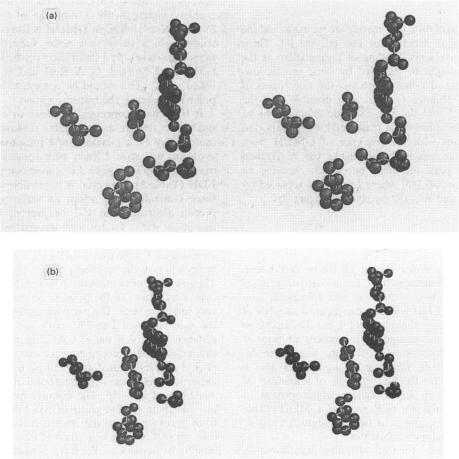
L-Lactate dehydrogenase (L-LDH) from Saccharomyces cerevisiae and L-mandelate dehydrogenase (L-MDH) from Rhodotorula graminis are both flavocytochromes b2. The kinetic properties of these enzymes have been compared using steady-state kinetic methods. The most striking difference between the two enzymes is found by comparing their substrate specificities. L-LDH and L-MDH have mutually exclusive primary substrates, i.e. the substrate for one enzyme is a potent competitive inhibitor for the other. Molecular-modelling studies on the known three-dimensional structure of S. cerevisiae L-LDH suggest that this enzyme is unable to catalyse the oxidation of L-mandelate because productive binding is impeded by steric interference, particularly between the side chain of Leu-230 and the phenyl ring of mandelate. Another major difference between L-LDH and L-MDH lies in the rate-determining step. For S. cerevisiae L-LDH, the major rate-determining step is proton abstraction at C-2 of lactate, as previously shown by the 2H kinetic-isotope effect. However, in R. graminis L-MDH the kinetic-isotope effect seen with DL-[2-2H]mandelate is only 1.1 +/- 0.1, clearly showing that proton abstraction at C-2 of mandelate is not rate-limiting. The fact that the rate-determining step is different indicates that the transition states in each of these enzymes must also be different.
来自酿酒酵母的L-乳酸脱氢酶(L-LDH)和来自禾本科红酵母的L-扁桃酸脱氢酶(L-MDH)均为黄素细胞色素b2。已使用稳态动力学方法比较了这些酶的动力学特性。通过比较它们的底物特异性发现这两种酶之间最显著的差异。L-LDH和L-MDH具有相互排斥的主要底物,即一种酶的底物是另一种酶的有效竞争性抑制剂。对酿酒酵母L-LDH已知三维结构的分子建模研究表明,该酶无法催化L-扁桃酸的氧化,因为空间位阻干扰了有效结合,特别是亮氨酸-230的侧链与扁桃酸的苯环之间。L-LDH和L-MDH之间的另一个主要差异在于速率决定步骤。对于酿酒酵母L-LDH,主要的速率决定步骤是乳酸C-2位的质子提取,如先前通过2H动力学同位素效应所表明的那样。然而,在禾本科红酵母L-MDH中,用DL-[2-2H]扁桃酸观察到的动力学同位素效应仅为1.1±0.1,清楚地表明扁桃酸C-2位的质子提取不是限速步骤。速率决定步骤不同这一事实表明,这些酶中每一种的过渡态也必然不同。