Errington J
Sir William Dunn School of Pathology, University of Oxford, United Kingdom.
Microbiol Rev. 1993 Mar;57(1):1-33. doi: 10.1128/mr.57.1.1-33.1993.
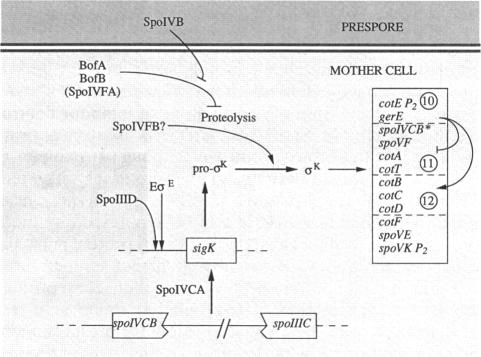
Bacillus subtilis sporulation is an adaptive response to nutritional stress and involves the differential development of two cells. In the last 10 years or so, virtually all of the regulatory genes controlling sporulation, and many genes directing the structural and morphological changes that accompany sporulation, have been cloned and characterized. This review describes our current knowledge of the program of gene expression during sporulation and summarizes what is known about the functions of the genes that determine the specialized biochemical and morphological properties of sporulating cells. Most steps in the genetic program are controlled by transcription factors that have been characterized in vitro. Two sporulation-specific sigma factors, sigma E and sigma F, appear to segregate at septation, effectively determining the differential development of the mother cell and prespore. Later, each sigma is replaced by a second cell-specific sigma factor, sigma K in the mother cell and sigma G in the prespore. The synthesis of each sigma factor is tightly regulated at both the transcriptional and posttranslational levels. Usually this regulation involves an intercellular interaction that coordinates the developmental programmes of the two cells. At least two other transcription factors fine tune the timing and levels of expression of genes in the sigma E and sigma K regulons. The controlled synthesis of the sigma factors and other transcription factors leads to a spatially and temporally ordered program of gene expression. The gene products made during each successive stage of sporulation help to bring about a sequence of gross morphological changes and biochemical adaptations. The formation of the asymmetric spore septum, engulfment of the prespore by the mother cell, and formation of the spore core, cortex, and coat are described. The importance of these structures in the development of the resistance, dormancy, and germination properties of the spore is assessed.
枯草芽孢杆菌的孢子形成是对营养胁迫的一种适应性反应,涉及两个细胞的分化发育。在过去大约10年里,几乎所有控制孢子形成的调控基因,以及许多指导伴随孢子形成的结构和形态变化的基因,都已被克隆和表征。本综述描述了我们目前对孢子形成过程中基因表达程序的认识,并总结了关于决定孢子形成细胞特殊生化和形态特性的基因功能的已知信息。遗传程序中的大多数步骤由在体外已被表征的转录因子控制。两个孢子形成特异性的σ因子,σE和σF,似乎在隔膜形成时分离,有效地决定了母细胞和前芽孢的分化发育。后来,每个σ因子被第二个细胞特异性的σ因子取代,母细胞中的σK和前芽孢中的σG。每个σ因子的合成在转录和翻译后水平都受到严格调控。通常这种调控涉及一种细胞间相互作用,以协调两个细胞的发育程序。至少还有另外两个转录因子微调σE和σK调控子中基因表达的时间和水平。σ因子和其他转录因子的受控合成导致了一个在空间和时间上有序的基因表达程序。在孢子形成的每个连续阶段产生的基因产物有助于引发一系列明显的形态变化和生化适应。描述了不对称孢子隔膜的形成、母细胞对前芽孢的吞噬以及孢子核心、皮层和外壳的形成。评估了这些结构在孢子抗性、休眠和萌发特性发育中的重要性。