Ibáñez C F, Ilag L L, Murray-Rust J, Persson H
Department of Medical Chemistry, Karolinska Institute, Stockholm, Sweden.
EMBO J. 1993 Jun;12(6):2281-93. doi: 10.1002/j.1460-2075.1993.tb05882.x.
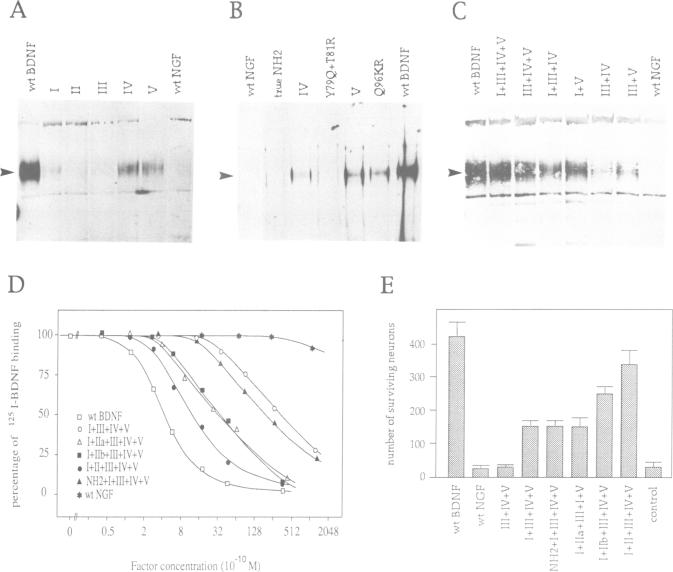
Neurotrophin-mediated cell survival and differentiation of vertebrate neurons is caused by ligand-specific binding to the Trk family of tyrosine kinase receptors. However, sites in the neurotrophins responsible for the binding to Trk receptors and the mechanisms whereby this interaction results in receptor activation and biological activity are unknown. Here we show that in nerve growth factor (NGF) and brain-derived neurotrophic factor (BDNF), discontinuous stretches of amino acid residues group together on one side of the neurotrophin dimer forming a continuous surface responsible for binding to and activation of TrkA and TrkB receptors. Two symmetrical surfaces are formed along the two-fold axis of the neurotrophin dimer providing a model for ligand-mediated receptor dimerization. Mutated neurotrophins inducing similar levels of receptor phosphorylation showed different biological activities, suggesting that structural differences in a ligand may result in dissimilar responses in a given tyrosine kinase receptor. Our results allowed us to combine structural elements from NGF, BDNF and neurotrophin-3 to engineer a pan-neurotrophin that efficiently activates all Trk receptors and displays multiple neurotrophic specificities.
神经营养因子介导的脊椎动物神经元的细胞存活和分化是由其与酪氨酸激酶受体Trk家族的配体特异性结合所引起的。然而,神经营养因子中负责与Trk受体结合的位点以及这种相互作用导致受体激活和生物活性的机制尚不清楚。在这里,我们表明,在神经生长因子(NGF)和脑源性神经营养因子(BDNF)中,不连续的氨基酸残基片段在神经营养因子二聚体的一侧聚集在一起,形成一个连续的表面,负责与TrkA和TrkB受体结合并激活它们。沿着神经营养因子二聚体的二重轴形成了两个对称的表面,为配体介导的受体二聚化提供了一个模型。诱导相似水平受体磷酸化的突变神经营养因子表现出不同的生物活性,这表明配体的结构差异可能导致给定酪氨酸激酶受体产生不同的反应。我们的结果使我们能够结合NGF、BDNF和神经营养因子-3的结构元件,设计出一种能有效激活所有Trk受体并表现出多种神经营养特异性的泛神经营养因子。