
核苷类似物家族的抗病毒药物可阻断容积激活的氯离子通道。
Antiviral drugs from the nucleoside analog family block volume-activated chloride channels.
作者信息
Gschwentner M, Susanna A, Wöll E, Ritter M, Nagl U O, Schmarda A, Laich A, Pinggera G M, Ellemunter H, Huemer H
机构信息
Department of Physiology, University of Innsbruck, Austria.
出版信息
Mol Med. 1995 May;1(4):407-17.
BACKGROUND
The antiviral drugs AZT and acyclovir are generally used in the treatment of infections with human immunodeficiency virus (HIV) and herpes simplex virus (HSV). These substances are known to impede virus replication by premature nucleic acid chain termination. It is not yet clear, however, if this is the sole mechanism responsible for the antiviral and/or the numerous side effects observed in patients treated with these agents. We investigated the swelling-induced chloride current in fibroblasts, which we demonstrated is closely related or identical to a cloned epithelial chloride channel, ICln: This chloride channel can be blocked by nucleotides.
MATERIALS AND METHODS
Electrophysiological, fluorescence optical, and volume measurements were made to determine the effect of nucleoside analogs on the swelling-dependent chloride current (ICl) in NIH 3T3 fibroblasts and in human T cell lymphoma (H9) cells and the cAMP-dependent chloride current in CaCo cells.
RESULTS
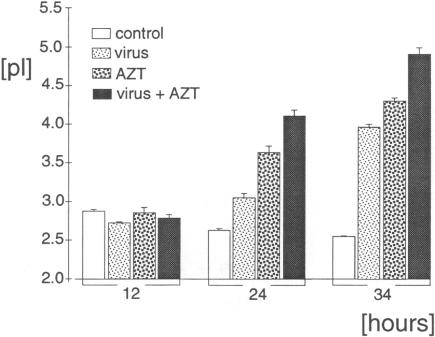
AZT and acyclovir block the swelling-dependent chloride current and the chloride flux in fibroblasts, and the regulatory volume decrease (RVD) and ICl in H9 cells. This immediate effect can be substantially reduced by the simultaneous incubation of the cells with thymidine-5'-diphosphate (TDP) or uridine, both of which are by themselves unable to affect ICl.
CONCLUSIONS
We show here a novel molecular mechanism by which antiviral drugs of the nucleoside analog family could lead to impairments of the kidney, bone marrow, gastrointestinal, and neuronal functions, and how these side effects could possibly be restricted by the presence of TDP or uridine.
背景
抗病毒药物齐多夫定(AZT)和阿昔洛韦通常用于治疗人类免疫缺陷病毒(HIV)和单纯疱疹病毒(HSV)感染。已知这些物质通过过早终止核酸链来阻碍病毒复制。然而,这是否是这些药物治疗患者中观察到的抗病毒和/或众多副作用的唯一机制尚不清楚。我们研究了成纤维细胞中肿胀诱导的氯离子电流,我们证明该电流与克隆的上皮氯离子通道ICln密切相关或相同:该氯离子通道可被核苷酸阻断。
材料与方法
进行电生理、荧光光学和体积测量,以确定核苷类似物对NIH 3T3成纤维细胞和人T细胞淋巴瘤(H9)细胞中肿胀依赖性氯离子电流(ICl)以及CaCo细胞中cAMP依赖性氯离子电流的影响。
结果
AZT和阿昔洛韦阻断成纤维细胞中肿胀依赖性氯离子电流和氯离子通量,以及H9细胞中的调节性容积减小(RVD)和ICl。细胞与胸苷-5'-二磷酸(TDP)或尿苷同时孵育可显著降低这种即时效应,而TDP和尿苷本身均无法影响ICl。
结论
我们在此展示了一种新的分子机制,核苷类似物家族的抗病毒药物可通过该机制导致肾脏、骨髓、胃肠道和神经功能受损,以及TDP或尿苷的存在如何可能限制这些副作用。
 Zotero 插件