Cereghino G P, Atencio D P, Saghbini M, Beiner J, Scheffler I E
Department of Biology 0322, University of California, San Diego, La Jolla 92093, USA.
Mol Biol Cell. 1995 Sep;6(9):1125-43. doi: 10.1091/mbc.6.9.1125.
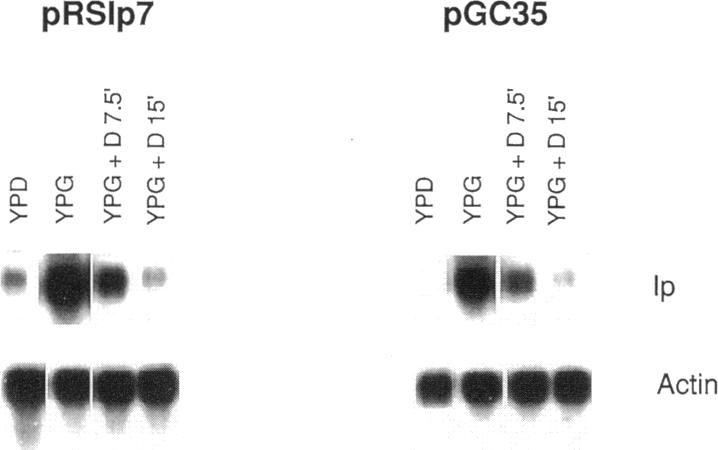
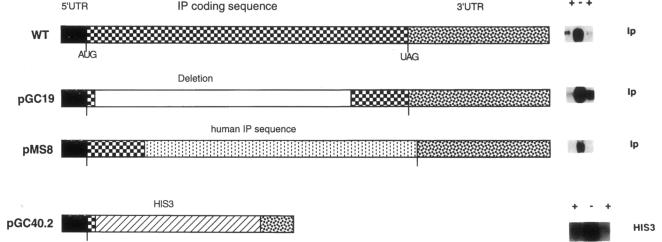
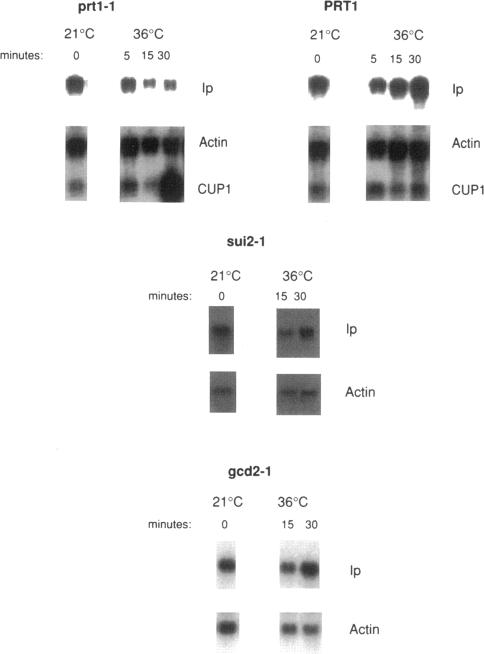
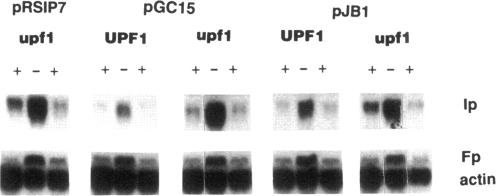
We have demonstrated previously that glucose repression of mitochondrial biogenesis in Saccharomyces cerevisiae involves the control of the turnover of mRNAs for the iron protein (Ip) and flavoprotein (Fp) subunits of succinate dehydrogenase (SDH). Their half-lives are > 60 min in the presence of a nonfermentable carbon source (YPG medium) and < 5 min in glucose (YPD medium). This is a rare example in yeast in which the half-lives are > 60 min in the presence of a nonfermentable carbon source (YPG medium) and < 5 min in glucose (YPD medium). This is a rare example in yeast in which the half-life of an mRNA can be controlled by manipulating external conditions. In our current studies, a series of Ip transcripts with internal deletions as well as chimeric transcripts with heterologous sequences (internally or at the ends) have been examined, and we established that the 5'-untranslated region (5' UTR) of the Ip mRNA contains a major determinant controlling its differential turnover in YPG and YPD. Furthermore, the 5' exonuclease encoded by the XRN1 gene is required for the rapid degradation of the Ip and Fp mRNAs upon the addition of glucose. In the presence of cycloheximide the nucleolytic degradation of the Ip mRNA can be slowed down by stalled ribosomes to allow the identification of intermediates. Such intermediates have lost their 5' ends but still retain their 3' UTRs. If protein synthesis is inhibited at an early initiation step by the use of a prt1 mutation (affecting the initiation factor eIF3), the Ip and Fp mRNAs are very rapidly degraded even in YPG. Significantly, the arrest of translation by the introduction of a stable hairpin loop just upstream of the initiation codon does not alter the differential stability of the transcript in YPG and YPD. These observations suggest that a signaling pathway exists in which the external carbon source can control the turnover of mRNAs of specific mitochondrial proteins. Factors must be present that control either the activity or more likely the access of a nuclease to the select mRNAs. As a result, we propose that a competition between initiation of translation and nuclease action at the 5' end of the transcript determines the half-life of the Ip mRNA.
我们之前已经证明,酿酒酵母中线粒体生物合成的葡萄糖抑制作用涉及对琥珀酸脱氢酶(SDH)铁蛋白(Ip)和黄素蛋白(Fp)亚基mRNA周转的控制。在非发酵碳源(YPG培养基)存在下,它们的半衰期>60分钟,而在葡萄糖(YPD培养基)中<5分钟。这在酵母中是一个罕见的例子,即在非发酵碳源(YPG培养基)存在下半衰期>60分钟,而在葡萄糖(YPD培养基)中<5分钟。这在酵母中是一个罕见的例子,即mRNA的半衰期可以通过操纵外部条件来控制。在我们目前的研究中,已经检测了一系列具有内部缺失的Ip转录本以及具有异源序列(内部或末端)的嵌合转录本,并且我们确定Ip mRNA的5'非翻译区(5'UTR)包含一个主要决定因素,控制其在YPG和YPD中的差异周转。此外,XRN1基因编码的5'核酸外切酶是添加葡萄糖后Ip和Fp mRNA快速降解所必需的。在环己酰亚胺存在下,停滞的核糖体可以减缓Ip mRNA的核酸降解,从而鉴定中间体。这些中间体已经失去了它们的5'末端,但仍然保留它们的3'UTR。如果通过使用prt1突变(影响起始因子eIF3)在早期起始步骤抑制蛋白质合成,即使在YPG中,Ip和Fp mRNA也会非常迅速地降解。值得注意的是,在起始密码子上游引入稳定的发夹环来阻止翻译,不会改变转录本在YPG和YPD中的差异稳定性。这些观察结果表明,存在一种信号通路,其中外部碳源可以控制特定线粒体蛋白mRNA的周转。必须存在控制核酸酶活性或更可能是其对选定mRNA的作用的因素。因此,我们提出转录本5'末端翻译起始和核酸酶作用之间的竞争决定了Ip mRNA的半衰期。