Guillery R W
Department of Anatomy, University of Oxford, UK.
J Anat. 1995 Dec;187 ( Pt 3)(Pt 3):583-92.
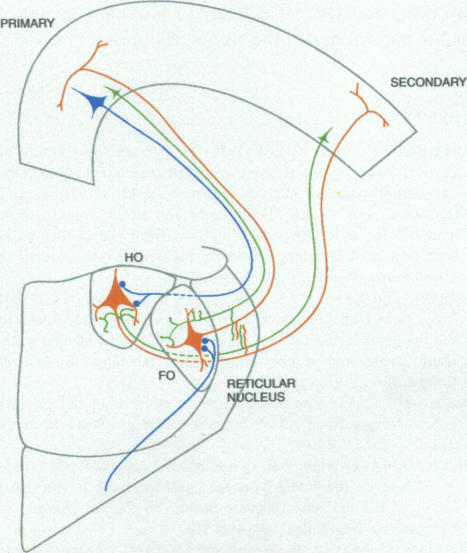
Two distinct types of thalamic nucleus are proposed on the basis of the afferent fibres that they receive from ascending pathways and from the cerebral cortex. 'First order nuclei' receive primary afferent fibres, definable on the basis of their origin and their intrathalamic synaptic relationships, from ascending pathways. These nuclei receive corticothalamic afferents from pyramidal cells in cortical layer 6, which also send branches to the thalamic reticular nucleus and appear to have a modulatory function. 'Higher order nuclei' receive most or all of their 'primary afferents' from pyramidal cells in cortical layer 5. These resemble the ascending primary afferents in the first order nuclei in terms of fine structure, synaptic relationships and in lacking a branch to the thalamic reticular nucleus. The higher order nuclei also receive modulatory afferents from layer 6. It is proposed that the higher-order nuclei are largely concerned with transmitting information about the output of one cortical area to another cortical area, and that they are likely to play a key role in corticocortical communication and higher cortical functions.
根据丘脑核从上行通路和大脑皮层接收的传入纤维,提出了两种不同类型的丘脑核。“一级核”接收来自上行通路的初级传入纤维,这些纤维可根据其起源和丘脑内的突触关系来定义。这些核从皮层第6层的锥体细胞接收皮质丘脑传入纤维,这些锥体细胞也向丘脑网状核发送分支,似乎具有调节功能。“高级核”的大部分或所有“初级传入纤维”来自皮层第5层的锥体细胞。这些纤维在精细结构、突触关系以及缺乏向丘脑网状核的分支方面,与一级核中的上行初级传入纤维相似。高级核还接收来自第6层的调节性传入纤维。有人提出,高级核主要负责将一个皮层区域的输出信息传递到另一个皮层区域,并且它们可能在皮层间通信和高级皮层功能中发挥关键作用。